


Define B2B YouTube campaign outcomes
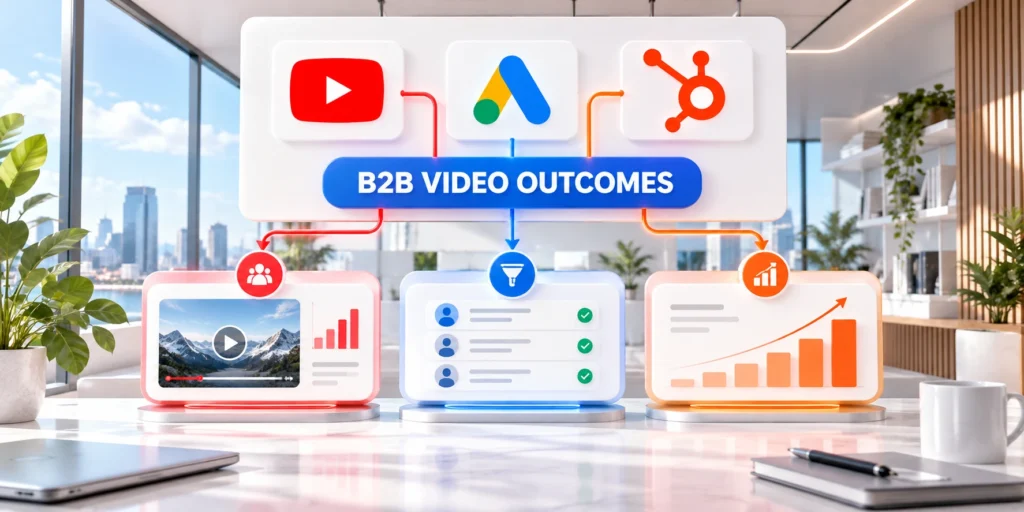
A B2B YouTube campaign needs a business outcome before it needs an audience or video. Start with the revenue decision the campaign should influence.
Separate attention, demand capture, and pipeline goals. Each goal needs its own conversion actions, time horizon, budget logic, and reporting expectations.
Map the buying journey before campaign setup
Document how prospects move from an unfamiliar problem to active evaluation. Include the people who research, recommend, approve, secure, procure, and use the solution.
Long sales cycles make one form submission an incomplete success signal. Connect website activity with qualification, opportunity creation, progression, and closed revenue.
| Business stage | Useful signal | Decision supported |
|---|---|---|
| Problem awareness | Qualified video reach | Message relevance |
| Active research | Engaged visit or content action | Offer fit |
| Evaluation | Qualified lead or meeting | Sales readiness |
| Pipeline | Opportunity and stage progression | Commercial quality |
| Revenue | Closed value and margin | Investment return |
Design conversion architecture around quality
Create primary conversions only for outcomes worth optimizing. Treat page views, video views, and shallow clicks as diagnostic signals unless they reliably predict pipeline.
Use this sequence to preserve data quality:
- Define the lead event and its required fields.
- Capture campaign and click identifiers where permitted.
- Deduplicate repeated submissions and CRM records.
- Standardize qualified, opportunity, and revenue stages.
- Return later-stage outcomes to the advertising platform.
- Monitor rejected uploads, latency, and missing identifiers.
Use consistent identifiers between advertising, website analytics, marketing automation, and CRM records. Document consent, retention, hashing, access, and deletion requirements before collecting customer data.
Set targets from unit economics
Work backward from acceptable customer acquisition cost, close rate, opportunity rate, and lead qualification rate. This creates a defensible ceiling for each upstream acquisition event.
Use conservative ranges when data is immature. A precise target built on unreliable attribution can automate budget toward low-value leads more quickly.
| Input | Example planning question | Owner |
|---|---|---|
| Average contract value | Which revenue basis is comparable? | Finance |
| Gross margin | What acquisition cost remains sustainable? | Finance |
| Qualified lead rate | Which leads meet acceptance criteria? | Marketing and sales |
| Opportunity rate | Which accepted leads enter pipeline? | Sales operations |
| Close rate | Which opportunities become customers? | Revenue operations |
Choose YouTube campaign type and inventory

Campaign type determines available inventory, optimization, bidding, and creative behavior. Choose it from the outcome and measurement readiness rather than from a familiar interface label.
Google currently supports video delivery through Video campaigns and Demand Gen. Demand Gen can combine video and image assets across YouTube and other Google surfaces.
Match the campaign to the job
Use reach or view-oriented formats when the immediate objective is credible category exposure. Use conversion-oriented configurations only after reliable conversion tracking is available.
Demand Gen is useful when teams need action across visual Google surfaces and want controlled creative testing. Channel selection should follow the intended experience and audience context.
| Campaign job | Planning emphasis | Primary caution |
|---|---|---|
| Category reach | Unique reach and frequency | Mistaking views for demand |
| Consideration | Engaged visits and qualified actions | Using weak offers |
| Lead acquisition | Qualified conversions and pipeline | Optimizing to low-quality forms |
| Account expansion | First-party audiences and exclusions | Poor data governance |
Plan for every viewing context
YouTube inventory spans television, desktop, mobile, vertical feeds, in-feed discovery, and in-stream viewing. One horizontal asset rarely communicates equally well everywhere.
Use these steps for device-ready creative:
- Keep the central subject clear on small screens.
- Use audio intentionally while preserving comprehension.
- Place important visual information inside safe areas.
- Show the brand and product early without delaying value.
- Use captions large enough for mobile viewing.
- Test landing pages on the same devices as the ads.
Create separate creative variants for wide, tall, and balanced placements. Reframe subjects, captions, demonstrations, and calls to action instead of cropping blindly.
Control placement and brand suitability
Define inventory, exclusions, geography, language, devices, frequency, and suitability rules before launch. Document who approves exceptions and how placement incidents are handled.
Avoid overconstraining conversion campaigns without evidence. Google advises broad targeting for conversion-focused video because narrow content filters can reduce eligible opportunities.
Align the landing experience with the video
Continue the same promise, audience language, proof, and next action on the landing page. A persuasive video cannot rescue an unrelated or confusing destination.
Use these controls to align the landing path:
- Repeat the central proposition from the video.
- Show evidence before requesting sensitive information.
- Explain what happens after form submission.
- Route high-intent requests to an accountable owner.
- Test page speed and form behavior on mobile.
- Preserve campaign attribution through approved methods.
Remove navigation and form fields only when doing so improves the buyer’s decision. Complex offers may require technical detail, privacy information, and implementation context.
Build B2B audience and targeting strategy

B2B targeting works through combinations of signals rather than a single job-title filter. Build audiences around problems, research behavior, first-party relationships, and buying roles.
Keep prospecting, customer expansion, and remarketing separate. Their creative, exclusions, offers, frequency, and success criteria differ materially.
Translate the buying committee into signals
List economic buyers, technical evaluators, operators, procurement, security, and executive sponsors. For each role, identify questions, objections, evidence needs, and likely research behavior.
Custom segments can use relevant search terms, URLs, and applications as signals. These inputs do not guarantee a specific employer or exact individual.
| Buying role | Common concern | Useful creative proof |
|---|---|---|
| Executive sponsor | Risk and business impact | Outcome and governance |
| Technical evaluator | Architecture and integration | Demonstration and documentation |
| Operations lead | Adoption and reliability | Workflow and support evidence |
| Procurement | Commercial fit | Scope and implementation clarity |
| Security reviewer | Controls and data handling | Validated process evidence |
Use first-party audiences responsibly
Link website, CRM, and YouTube engagement only through approved account connections. Build segments for customers, active opportunities, known leads, engaged viewers, and relevant site visitors.
Apply these safeguards to first-party audiences:
- Confirm the lawful basis for customer data use.
- Restrict access to audience creation and uploads.
- Apply retention and deletion rules consistently.
- Monitor audience size and unexpected membership changes.
- Separate acquisition from customer marketing.
- Document every exclusion and business reason.
Exclude customers from acquisition when the offer is unsuitable. Exclude employees, partners, recent converters, and irrelevant geographies when those records are reliable and permitted.
Create a testing architecture
Start with distinct audience hypotheses instead of many overlapping ad groups. Each test should isolate a meaningful difference in role, problem, stage, or signal source.
Prevent internal competition by documenting exclusions and overlap. Use stable naming for campaign, audience, creative, offer, geography, and experiment version.
Coordinate video with the demand system
Connect this structure to the broader B2B demand generation system so video engagement supports coordinated sales and content follow-up.
Keep the same qualification criteria and reporting window across channels so sales teams can compare demand signals without blending unrelated outcomes.
Produce B2B video creative that earns attention

Effective B2B creative respects a busy viewer and a complex decision. Present the problem, relevance, proof, and next action without forcing a complete product presentation.
Google describes effective video through Attention, Branding, Connection, and Direction. Translate those principles into the language and evidence expected by business buyers.
Build one proposition per asset
Choose one audience, one high-value problem, one credible promise, and one action. Multiple unrelated claims weaken memory and make performance diagnosis difficult.
Use this sequence to construct each asset:
- Open with a recognizable business problem.
- Identify the affected role or process.
- Show the mechanism behind the solution.
- Provide verifiable evidence or demonstration.
- Address one important objection.
- State the next action clearly.
Use the first seconds to establish relevance. Show the business consequence, operational friction, customer situation, or surprising result before explaining the company history.
Match proof to buying stage
Early-stage viewers need a useful framing of the problem. Evaluation-stage buyers need demonstrations, integration detail, implementation expectations, customer evidence, and risk reduction.
Avoid unsupported superlatives, invented customer results, and vague claims. Obtain permission for customer logos, testimonials, screen recordings, and third-party marks before publication.
| Stage | Creative concept | Offer |
|---|---|---|
| Awareness | Problem reframing | Guide or diagnostic |
| Consideration | Workflow demonstration | Technical briefing |
| Evaluation | Implementation proof | Assessment or consultation |
| Expansion | Advanced use case | Account workshop |
Design a practical creative system
Produce modular openings, demonstrations, proof points, and calls to action. A modular system creates meaningful variants without rebuilding every asset from zero.
Use these steps to produce useful variants:
- Record a concise master narrative.
- Create multiple opening hooks.
- Export horizontal, vertical, and square versions.
- Prepare captioned and voice-led variants.
- Maintain approved claims and brand assets.
- Archive source files and experiment notes.
Change one major variable per experiment. Testing a new audience, opening, offer, duration, and landing page simultaneously prevents a clear conclusion.
Measure pipeline and optimize YouTube ads
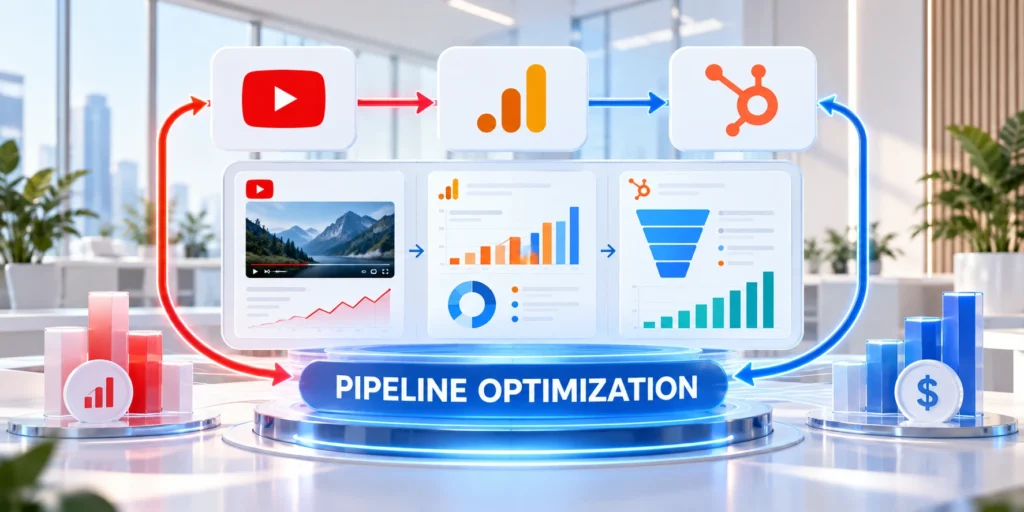
Optimization should move from delivery to attention, qualified action, pipeline, and revenue. No single metric can represent every stage of a B2B decision.
Use platform metrics for delivery decisions and CRM outcomes for commercial decisions. Reconcile identifiers, attribution windows, currency, time zones, and duplicate records.
Build a decision dashboard
Report spend, reach, frequency, views, engaged visits, conversions, qualified leads, opportunities, pipeline value, revenue, and data freshness in one operating view.
Segment results by campaign, audience hypothesis, creative concept, offer, geography, device, and sales stage. Suppress tiny samples that invite unstable conclusions.
| Metric layer | Question | Decision |
|---|---|---|
| Delivery | Did the campaign reach eligible viewers? | Budget and inventory |
| Attention | Did viewers engage with the message? | Creative direction |
| Website | Did visits complete useful actions? | Offer and landing page |
| Pipeline | Did leads become opportunities? | Audience and qualification |
| Revenue | Did value justify acquisition cost? | Scale or reallocate |
Return qualified outcomes to Google Ads
Enhanced conversions for leads can connect later CRM outcomes with earlier advertising interactions using approved first-party data. Implement consent, hashing, and governance before activation.
Follow these steps to return qualified outcomes:
- Audit website conversion tracking.
- Verify CRM stage definitions and ownership.
- Map eligible outcome events.
- Validate data handling and consent.
- Test with a controlled record set.
- Compare platform and CRM totals.
- Monitor errors and delayed updates.
Monitor upload success, match quality, event timing, duplicate prevention, and stage definitions. A technically successful upload can still optimize toward inconsistent business labels.
Run controlled optimization cycles
Allow sufficient observation time for the campaign objective, conversion volume, and sales cycle. Avoid daily restructuring that resets learning and obscures cause.
Use these controls for measured optimization:
- Pause clear tracking defects immediately.
- Correct unsuitable placements or policy risks promptly.
- Wait for meaningful evidence before judging normal variance.
- Scale only when lead quality remains stable.
- Protect a budget for new creative learning.
- Review lost opportunities with sales teams.
Use experiments for creative strategy and document the hypothesis, primary metric, guardrails, audience, dates, sample limitations, result, and next decision.
Create a sales feedback loop
Ask sales teams to classify lead relevance, buying role, company fit, urgency, objection, and outcome using consistent fields rather than informal comments.
Follow these steps to improve sales feedback:
- Select a representative lead sample.
- Compare marketing and sales classifications.
- Identify recurring quality patterns.
- Trace those patterns to audience, creative, and offer.
- Change one controllable variable.
- Measure both volume and later-stage quality.
Review samples of accepted and rejected leads with marketing. Differences between teams often reveal unclear qualification rules, routing delays, or mismatched campaign promises.
Use a launch governance checklist
Assign owners for budget, creative approval, conversion tracking, privacy, CRM data, landing pages, sales routing, and incident response before enabling spend.
Confirm these controls before enabling spend:
- Conversion actions tested with known records
- Audience permissions and exclusions reviewed
- Creative claims and rights approved
- Landing page and form tested
- CRM routing and response service level confirmed
- Dashboard definitions documented
- Budget alerts and stop conditions enabled
Record the approved campaign state and rollback conditions. Untracked edits to audiences, goals, bidding, or exclusions can invalidate comparisons and compliance evidence.
Define operating criteria before execution
For YouTube Ads for B2B demand generation, define audience, offer, video message, and follow-up path before changing campaigns, code, content, or workflow.
Use these decisions before campaign execution:
- Write the decision, owner, assumptions, and known constraints.
- Identify dependencies that could change the expected result.
- Set a reversible first step when uncertainty remains.
- Keep the decision record accessible to contributors.
- State what evidence is sufficient to proceed.
- Note which decisions cannot be reversed cheaply.
- Define the time frame for the decision.
- Record the intended business benefit.
- Confirm the available capacity and budget.
That shared context gives every contributor a practical boundary for action.
Test the workflow under realistic conditions
Evaluate YouTube Ads for B2B demand generation across the real targeting, creative, landing experience, and CRM follow-up sequence.
Follow these steps to test the whole workflow:
- Choose a representative task or audience segment.
- Run the workflow from its first input to the final outcome.
- Capture exceptions, delays, and manual work.
- Compare results with the agreed baseline.
- Decide whether to improve, repeat, or scale.
- Document the limits of the test.
- Confirm that owners can support the next step.
- Review assumptions with people doing the work.
- Capture feedback from affected customers or users.
A narrow test can hide handoff issues, exceptions, integration failures, or user behavior.
Measure outcomes and tradeoffs together
Track qualified viewing, lead quality, opportunity creation, and pipeline influence together rather than optimizing a single favorable metric.
Use these checks when reviewing campaign outcomes:
- Use business and technical indicators in the same review.
- Record data gaps before interpreting a result.
- Explain material changes with evidence, not timing alone.
- Preserve the baseline and reporting period.
- Share findings with the teams responsible for follow-up.
- Check whether the outcome can be reproduced.
- State the confidence level behind each conclusion.
- Compare actual effort against the original estimate.
- Assign responsibility for the next reporting cycle.
Costs, risk, quality, and effort can otherwise distort the apparent value.
Keep the practice current
Review the approach when audience, creative, budget, or sales feedback changes.
Use these actions to maintain the operating practice:
- Schedule ownership and review dates with the operating team.
- Retire outdated instructions, definitions, and unsupported claims.
- Record the next action and accountable owner.
- Link related internal guidance when it helps execution.
- Decide whether to improve, replace, or stop the practice.
- Share changed instructions with affected contributors.
- Keep the latest decision record easy to find.
- Confirm whether the documented standard remains usable.
- Escalate material risks before the next release.
Past decisions may still help, but their assumptions require current evidence.
Connect Creative Tests to Sales Learning
Share the audience, promise, proof, offer, and landing context with sales so representatives can interpret resulting conversations consistently.
Capture disqualification reasons and buyer questions, then use those patterns to refine targeting, creative, qualification, and follow-up.
Protect Brand and Measurement Continuity
Use approved claims, review placements, preserve campaign identifiers, and document material changes before comparing performance periods.
When creative or tracking fails, pause the affected path and preserve evidence instead of resetting the campaign without explanation.
Set budget, bids, and control limits
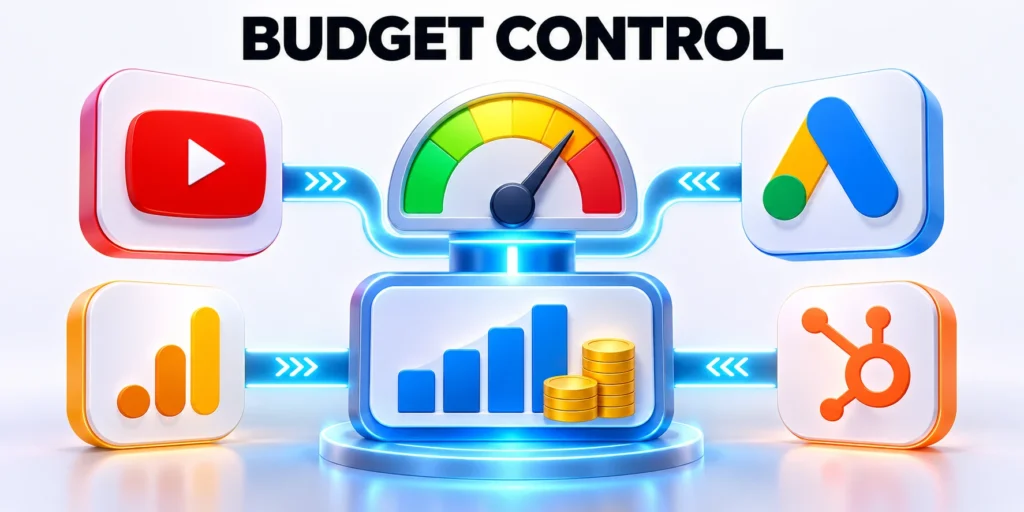
Budgeting should reflect a tested business case, not an arbitrary platform recommendation or a desire to buy reach quickly.
Set a learning allocation separately from scalable spend so one failed creative or audience hypothesis cannot distort commercial decisions.
Translate unit economics into a campaign boundary
Start with the maximum acceptable acquisition cost, expected qualification rate, opportunity conversion, gross margin, and realistic sales-cycle timing.
Work backward from revenue quality instead of treating a low cost per view as proof that a B2B campaign is efficient.
Use these controls before allocating additional spend:
- Set a daily ceiling and review threshold.
- Separate testing funds from proven campaign budget.
- Document the bidding objective and guardrails.
- Exclude low-value audiences before scaling.
- Pause spend after tracking or routing failure.
- Keep evidence specific to set budget, bids, and control limits.
- Review results before expanding the scope.
Review bid changes against downstream evidence
Change bids only after reviewing delivery, qualified actions, CRM outcomes, and whether the audience still matches the original buying hypothesis.
A more aggressive bid can improve impressions while lowering commercial quality, especially when creative attracts curiosity rather than qualified evaluation.
Document set budget, bids, and control limits
Assign a named owner to record the baseline, evidence window, limitations, expected effect, and reversal condition for set budget, bids, and control limits.
That record prevents isolated platform metrics from becoming the only explanation when set budget, bids, and control limits changes performance, lead quality, or operating risk.
Connect YouTube engagement to CRM qualification

Video engagement becomes useful only when the organization defines which behaviors warrant follow-up and which remain anonymous learning signals.
Map campaign identifiers, consent, landing actions, ownership, and CRM stages before importing any conversion event into an optimization loop.
Define a qualification handoff that sales can trust
Marketing and sales should agree on account fit, buying role, demonstrated need, timing, exclusions, and the evidence required before routing.
Those definitions prevent a campaign from receiving credit for form submissions that sales cannot contact, qualify, or progress responsibly.
Record these fields for every qualified handoff:
- Campaign and creative identifier
- Consent and conversion timestamp
- Account fit and buying role
- Lead owner and response deadline
- CRM stage and disqualification reason
- Keep evidence specific to connect youtube engagement to crm qualification.
- Review results before expanding the scope.
Reconcile records before interpreting performance
Reconcile platform conversions with CRM records by identifier, attribution window, event time, duplicate handling, and the definition of each lifecycle stage.
When records disagree, investigate the handoff before changing targeting. A tracking mismatch can look like an audience problem when it is not.
Document connect youtube engagement to crm qualification
Assign a named owner to record the baseline, evidence window, limitations, expected effect, and reversal condition for connect youtube engagement to crm qualification.
That record prevents isolated platform metrics from becoming the only explanation when connect youtube engagement to crm qualification changes performance, lead quality, or operating risk.
Use video sequences for B2B buying stages

A buying committee rarely moves from a first video to a sales meeting in one step, particularly when the offer involves operational change.
Sequence useful evidence across discovery, evaluation, and decision stages while allowing viewers to exit when the next message is not relevant.
Match each sequence step to a decision question
Early messages can frame a costly problem, while later messages should demonstrate feasibility, implementation expectations, proof, and accountable next actions.
Avoid forcing every viewer through the same series. Use engagement and first-party context to suppress irrelevant steps and preserve frequency discipline.
Plan each stage around a buyer decision:
- Recognize the operational problem
- Compare credible solution approaches
- Validate technical and commercial fit
- Prepare the internal business case
- Choose a practical next conversation
- Keep evidence specific to use video sequences for b2b buying stages.
- Review results before expanding the scope.
Keep the landing path consistent with the sequence
The landing page should continue the claim, terminology, proof, and expected action from the video rather than restart the buyer journey.
Review the path with sales and product teams. Their objections often reveal when a sequence needs stronger evidence or a clearer transition.
Document use video sequences for b2b buying stages
Assign a named owner to record the baseline, evidence window, limitations, expected effect, and reversal condition for use video sequences for b2b buying stages.
That record prevents isolated platform metrics from becoming the only explanation when use video sequences for b2b buying stages changes performance, lead quality, or operating risk.
Protect brand suitability and measurement integrity

Brand suitability and measurement quality are operating controls, not campaign settings that can be reviewed only after performance declines.
Document approvals, placement controls, tracking changes, and incident ownership before scaling a campaign that will influence business decisions.
Make suitability criteria explicit before launch
Define unacceptable content environments, sensitive themes, geographic limitations, audience exclusions, claims standards, and escalation paths with accountable owners.
Use those criteria to review inventory, creative, and landing pages consistently instead of relying on a last-minute subjective judgment.
Check these conditions before approving a campaign:
- Placement exclusions reflect current brand guidance
- Creative claims have accountable approval
- Conversion events use consistent definitions
- Consent and data access remain documented
- Incident owners can pause affected activity
- Keep evidence specific to protect brand suitability and measurement integrity.
- Review results before expanding the scope.
Preserve evidence when a control changes
Record the old state, reason, owner, date, and expected effect whenever targeting, creative, conversion goals, or exclusions materially change.
That history makes performance comparisons credible and helps teams restore a safe configuration when a deployment or data change fails.
Document protect brand suitability and measurement integrity
Assign a named owner to record the baseline, evidence window, limitations, expected effect, and reversal condition for protect brand suitability and measurement integrity.
That record prevents isolated platform metrics from becoming the only explanation when protect brand suitability and measurement integrity changes performance, lead quality, or operating risk.
Run a controlled optimization cycle

Optimization works when each change is tied to a hypothesis, baseline, observation window, owner, guardrail, and documented next decision.
This discipline protects the budget from reactive daily edits that make it impossible to identify whether creative, audience, offer, or routing caused movement.
Choose one material variable for each test
Test a substantial difference such as a problem framing, audience signal, proof type, offer, or landing path rather than a cosmetic variation.
Keep other material conditions stable long enough to observe qualified outcomes. Small samples and long sales cycles require explicit uncertainty in the decision record.
Use this sequence for controlled campaign learning:
- State the hypothesis and expected effect
- Preserve a comparable baseline period
- Assign an accountable experiment owner
- Monitor quality and safety guardrails
- Decide to scale, improve, or stop
- Keep evidence specific to run a controlled optimization cycle.
- Review results before expanding the scope.
Close the loop with revenue and sales evidence
Review opportunity creation, pipeline, accepted meetings, lost reasons, and revenue alongside delivery metrics before declaring an advertising improvement successful.
Share the learning with sales, creative, and operations teams. Their feedback turns a one-off campaign result into a more reliable demand-generation practice.
Document run a controlled optimization cycle
Assign a named owner to record the baseline, evidence window, limitations, expected effect, and reversal condition for run a controlled optimization cycle.
That record prevents isolated platform metrics from becoming the only explanation when run a controlled optimization cycle changes performance, lead quality, or operating risk.
FAQ
These answers address common planning decisions for YouTube advertising in complex B2B sales.
Should a B2B campaign optimize for video views or leads?
Choose the metric that matches the campaign job. Views support attention goals, while qualified conversions and later CRM outcomes better support acquisition decisions.
Can YouTube target specific companies or job titles?
Audience signals can approximate business intent and characteristics, but they do not guarantee exact individuals. Combine approved first-party data, relevant signals, and qualification controls.
How many video variants should launch together?
Launch enough distinct concepts to test meaningful hypotheses without fragmenting the budget. Prioritize different openings, propositions, proof, and calls to action over cosmetic changes.
When should CRM conversions be imported?
Import later-stage outcomes after stage definitions, consent, identifiers, deduplication, and monitoring are reliable. Inconsistent CRM data can train optimization toward the wrong result.
How long should a YouTube campaign run before optimization?
Use the conversion volume and buying cycle as the guide. Fix tracking defects immediately, but avoid frequent strategic changes before enough comparable evidence accumulates.
Should YouTube Ads use customer lists?
Use approved first-party data only when consent, policy, matching purpose, retention, exclusions, and account access are governed.
How should video frequency be reviewed?
Review frequency with reach, audience size, conversion quality, fatigue, and buying-cycle context rather than using one universal limit.
Can short videos work for B2B demand?
Yes, when they communicate one relevant problem, credible outcome, evidence, and next step without oversimplifying the offer.
What should a B2B video landing page contain?
Maintain message continuity, clarify audience and value, provide evidence, minimize unnecessary friction, and explain the next step.
When should a YouTube campaign be paused?
Pause after tracking failure, unsafe placement, unsupported claims, unusable follow-up, uncontrolled spend, or materially poor lead quality.
Conclusion

B2B YouTube advertising earns its place when a relevant video, accountable follow-up, and reliable measurement form one coherent demand-generation system.
Start with a bounded hypothesis, protect suitability and data quality, then scale only when qualified pipeline evidence supports the investment.
Turn video activity into a managed commercial system
The strongest campaigns connect audience evidence, a useful message, a clear next step, responsive sales ownership, and a measurement design that survives operational scrutiny.
Each connection matters because a failure in routing, consent, creative relevance, or CRM definition can invalidate an otherwise efficient media result.
Keep these decisions visible throughout the campaign:
- Audience and exclusion criteria
- Creative claim approvals
- Qualified conversion definitions
- Budget and safety guardrails
- Sales response ownership
Scale only after the whole path holds together
Review delivery, engagement, qualified demand, pipeline, and revenue together. A campaign should not receive expansion budget merely because an early metric looks attractive.
Use the next cycle to improve the material constraint, preserve comparable evidence, and share the result with every team responsible for the buyer journey.
Keep the program accountable after launch
Name the owner for budget, creative approval, measurement integrity, sales follow-up, and incident response. Accountability turns campaign activity into a manageable operating system.
Use recurring reviews to preserve what works, correct a documented constraint, and retire tactics that no longer match buyer behavior or commercial evidence.







Leave a Reply