


What Meta Content Syndication Means

Traditional B2B syndication uses publishers to distribute an asset and provide contacts under agreed criteria. With Meta, the advertiser buys media and controls creative, audience, destination, and follow-up.
Meta Ads for B2B content syndication is paid social promotion, even when the campaign aims to generate downloads or leads. Report it separately from publisher-supplied syndication contacts.
The practical distinction
An impression or form submission does not prove that an account is buying. Meta optimizes for configured events; CRM data and sales review determine qualification.
Define the goal first: build awareness with a report, capture prospects, or retarget existing audiences. Each requires a different offer and success measure.
Compare these three distribution routes consistently:
- Paid social distribution: pay Meta for audience reach; measure responses on-platform and onsite.
- Publisher syndication: partners distribute assets to audiences and deliver contacts under contractually defined qualification criteria.
- Owned distribution: email, community, website, or sales teams share assets with people already reachable.
Do not compare channels by raw lead counts. Compare cost and downstream quality using one shared qualification definition.
Choose the objective, conversion location, and performance goal that fit your business outcome. Meta Blueprint explains these settings in its campaign objectives and conversion settings course.
Separate distribution from demand proof
Paid distribution can expose an asset to relevant professionals, but a click or download does not establish buying intent, account fit, or incremental demand.
Use CRM outcomes and comparable cohorts to judge whether the channel introduces useful prospects or merely collects low-friction responses.
When Meta Ads Fit B2B Content Syndication

Meta may fit when platform signals reach relevant people, the asset reads clearly in feeds, and your team can nurture interest after the first interaction.
It is a weaker fit if you must reach a tiny named-account list, explain a complex offer, or lack capacity to qualify responses.
Match the channel to the buying situation
Use Meta as an additional touchpoint, not precise account targeting. It can introduce useful ideas and support retargeting when consent, policy, and audience size allow.
For high-consideration purchases, offer a concrete learning asset before asking for a meeting. A first conversion may signal curiosity, not purchase intent.
| Situation | Meta fits when | Prefer another route |
|---|---|---|
| Audience discovery | Professional segment is testable | Named-account coverage is mandatory |
| Lead capture | Offer explains a clear exchange | Qualification needs a live discussion |
| Retargeting | Permitted audience is large enough | Consent or frequency is uncertain |
| Measurement | CRM stages connect to cohorts | Only form totals are available |
Targeting labels do not guarantee seniority, authority, or account fit. Validate company, role, and sales relevance in the CRM.
Meta can complement search for broader demand generation. Our B2B Google Ads playbook covers capturing people already researching solutions.
Meta fits best under these practical conditions:
- The audience can be described without excessive narrowing
- The asset solves a recognizable business problem
- CRM stages can validate lead quality
- Consent and follow-up expectations are explicit
Account for audience and delivery constraints
Small professional audiences can saturate quickly, while broad segments may weaken fit. Set frequency, geography, exclusions, and review thresholds before interpreting delivery results.
Confirm that lawful targeting options can represent the intended market. If they cannot, choose a channel with stronger account or role coverage.
Choose a B2B Content Syndication Offer

A strong offer solves a defined problem without requiring a sales call. Use an original benchmark, implementation checklist, technical guide, or decision worksheet for a specific operational or buying decision.
Ask someone outside marketing who needs the asset and what they can do with it. If the answer is vague, improve it before buying distribution.
A practical offer review
Confirm that the asset addresses one recognizable decision for a defined role. Broad thought leadership rarely provides enough context for meaningful lead qualification.
The offer should disclose its format, practical value, evidence, and expected follow-up before the reader submits information.
Review each offer against these practical criteria:
- Specific audience: name the role, company situation, and problem the asset addresses.
- Immediate utility: show a useful takeaway, not just a promise of future insights.
- Credible evidence: identify the method, source, date, and limitations behind benchmarks or research.
- Clear next step: let readers decide whether they want a related product discussion.
- Accessible format: ensure mobile readability and avoid forms requesting unnecessary details.
- Decision relevance: connect the asset to a real operational choice.
Verify usefulness before buying additional reach
Ask a representative reader to explain the asset’s purpose, intended decision, and practical next step before campaign launch. Confusion at this stage predicts weak qualification later.
Test the asset on mobile, confirm evidence and dates, and remove vague claims. Distribution should amplify proven usefulness instead of compensating for an unclear offer.
Choose the conversion location deliberately
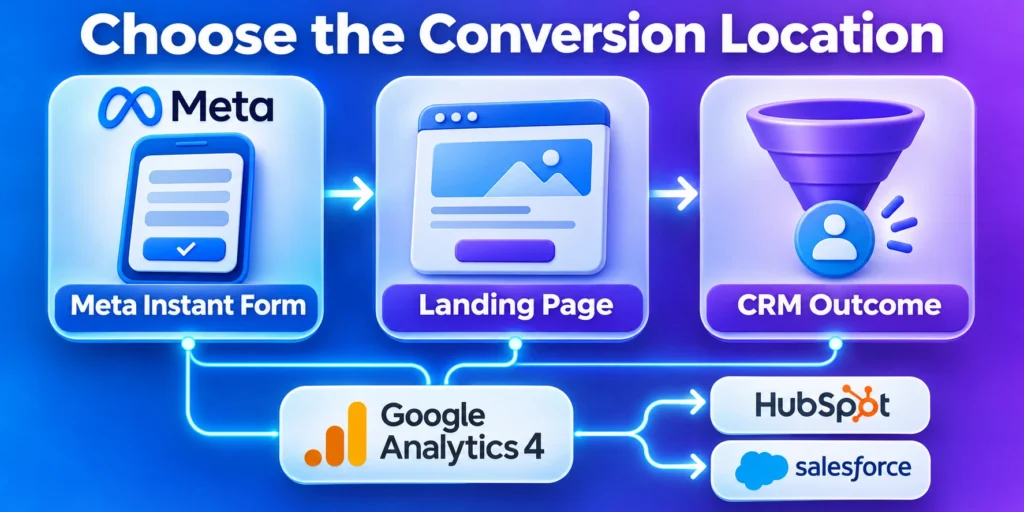
Instant forms reduce steps. Landing pages explain the asset and measure on-site behavior, but add loading time and form friction.
Neither is universally better. Compare both with one audience, offer, follow-up, and lead-quality rule. Change one major variable at a time.
Compare these controls across both conversion paths:
- Message continuity from advertisement to confirmation
- Mobile load time and form completion
- Consent clarity and requested information
- CRM routing and source preservation
- Qualified outcomes after equivalent follow-up
Test destinations under equivalent conditions
Keep audience, offer, creative promise, qualification rule, follow-up owner, and review window consistent when comparing instant forms with landing pages.
Record completion, acceptance, opportunity, and rejection reasons for each path. Cheap submissions matter only when they retain useful downstream quality and trust over time.
Set expectations and protect lead trust
Meta describes instant forms and CRM lead outcomes in its guide. Treat it as documentation, not a guarantee: Metaâs lead generation guide.
Explain privacy and expected follow-up plainly. Collect only useful information, and confirm the form and data flow meet applicable requirements.
Validate the offer before expanding distribution
Review the asset with sales and subject-matter experts before launch. Correct weak claims, unclear audience language, and missing implementation detail before buying reach.
A useful offer earns attention because it helps a specific business decision, not because the form promises a vague report or consultation.
Build a Controlled Meta Ads Test
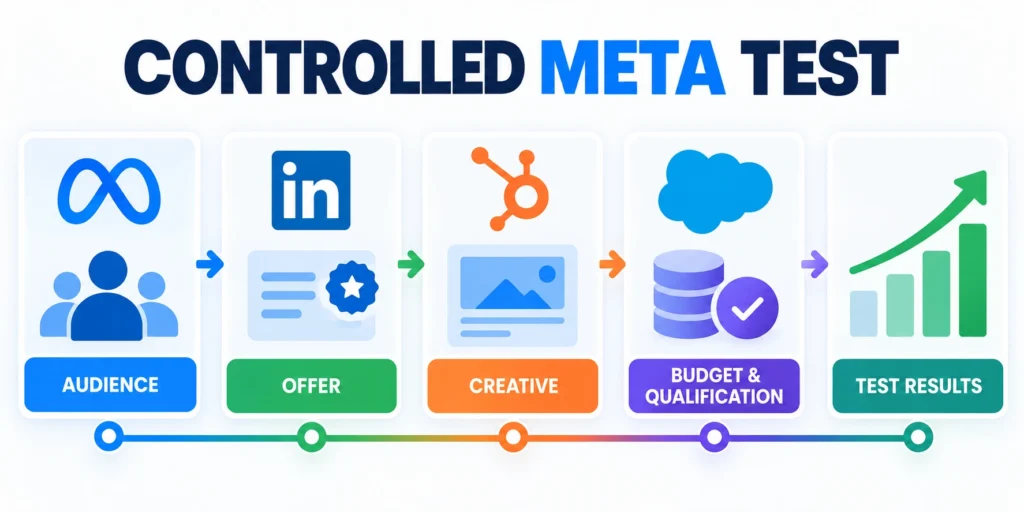
Test one question, such as whether a landing page yields more sales-accepted leads than an instant form. Record the hypothesis, audience, offer, event, spend cap, and decision date.
Keep the experiment narrow. Small B2B audiences may need time to produce qualified outcomes; do not choose a winner from a few cheap submissions.
Launch checklist
Translate the experiment into one shared launch record covering the question, audience, offer, destination, measurement, follow-up, safeguards, and decision date.
Confirm each dependency before spending. A campaign cannot produce interpretable evidence when the form, CRM mapping, consent, or qualification rule remains unsettled.
Confirm these dependencies before launching the test:
- Set the objective: choose a campaign objective and performance goal aligned with the intended action.
- Define the audience: document inclusions, exclusions, geography, language, and any lawful customer-list use.
- Prepare one offer: use a page or form explaining asset, value, privacy, and follow-up.
- Validate measurement: test page, form, CRM mapping, source fields, events, and consent.
- Set guardrails: choose spend cap, review cadence, frequency watch, and rules for pausing misleading ads.
- Run one comparison: change destination or creative angle while keeping other variables stable.
- Review cohorts: compare campaign and date cohorts after sufficient qualification time and sales feedback.
Use follow-up as part of the experiment
Assign an owner and response time. Prompt, relevant follow-up clarifies intent; a generic sequence can make a good campaign appear weak.
Map campaign and offer IDs to CRM records. Keep original source and later touches separate to show what introduced a prospect and what advanced the opportunity.
Connect ad responses to CRM outcomes
If offline outcomes matter, connect CRM stages to ad measurement where supported. See our offline conversion tracking guide for the wider measurement discipline.
Test at least one representative record through the complete handoff before launch, then monitor sync failures and unmatched outcomes throughout the experiment.
Measure B2B Lead Quality and Economics
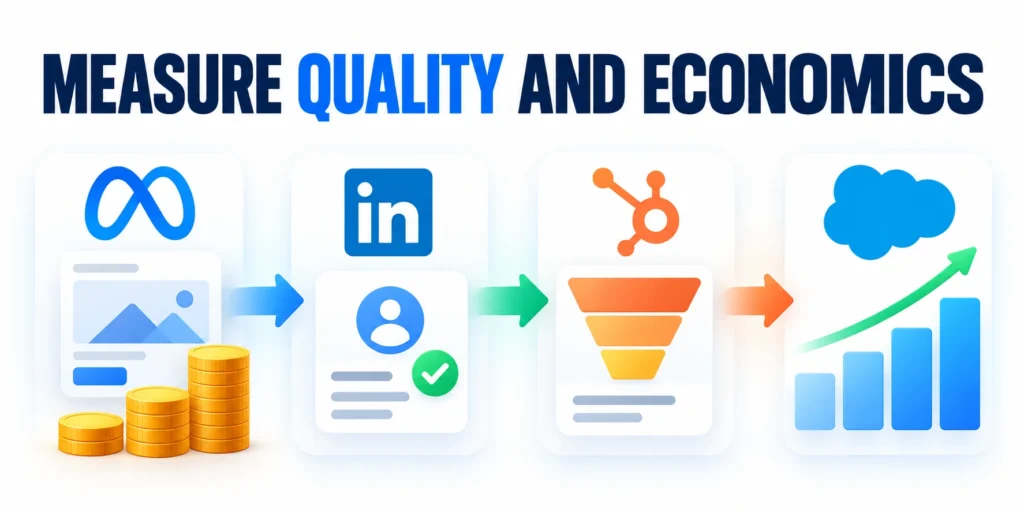
Report delivery separately from business outcomes. Impressions, clicks, views, and submissions describe activity, not qualified demand or incremental revenue.
Define a qualified lead and record rejection reasons. Repeated rejections may point to targeting, offer, form, or follow-up problems.
| Metric | What it reveals | Audit use |
|---|---|---|
| Landing-page view cost | Page attracts usable visits | Diagnose delivery only |
| Form completion rate | Destination earns submissions | Review friction and fit |
| Qualified-lead rate | Leads match agreed criteria | Compare audience and offer |
| Sales-accepted lead cost | Accepted prospect cost | Compare equal definitions |
| Opportunity contribution | Cohorts reach pipeline | Use mature CRM stages |
A simple calculation
Example: $4,000 across 80 submissions equals $50 each. If 12 are sales-accepted, the accepted-lead cost is about $333.
That second figure changes the decision. Looking only at the $50 submission cost may scale a source that produces few usable prospects.
Allow time for outcomes to mature
These figures are illustrative, not benchmarks. Use your sales cycle, margins, conversion rates, and evaluation window. Do not compare immature cohorts with mature opportunities.
Use a holdout or well-designed split test when possible. Attribution assigns credit under a model; it does not prove the ad caused an outcome.
Troubleshoot before changing the budget
Diagnose the broken stage before increasing or cutting spend. Delivery, destination, form, routing, qualification, and attribution failures require different corrections.
Use campaign cohorts and rejection reasons to isolate the problem. Budget changes cannot repair a weak asset, missing consent, or delayed sales response.
Use these signals to locate the weak stage:
- Clicks without page views: check mobile speed, errors, redirects, and landing-page message alignment.
- Views without submissions: review preview, headline, form friction, privacy clarity, and value exchange.
- Many weak-fit submissions: compare firmographics and rejection reasons; adjust qualification only with consistent evidence.
- Good leads without follow-up: verify routing, alerts, CRM ownership, and response-time expectations.
- Campaign and CRM totals disagree: reconcile duplicates, identifiers, attribution windows, consent, and event mapping.
- Sharp fluctuations: annotate changes and compare cohorts across suitable sales-cycle windows.
- Rising costs after expansion: review frequency, overlap, placements, and qualified-lead rate before scaling.
- Unusually strong attribution: compare platform conversions against CRM records and available holdouts.
Decide Whether to Scale or Revise Meta Ads

Decide using evidence and uncertainty. A campaign may look promising while its sales cycle remains open, or weak after repeated unqualified responses.
A low cost per lead is not enough to scale. Confirm the team can follow up and downstream quality fits the companyâs economics.
Choose the next action from these evidence patterns:
- Scale cautiously: qualification stays stable, tracking reliable, and budget increases observable without exhausting audiences.
- Revise the offer: engagement is reasonable, but prospects do not understand value or next steps.
- Revise targeting: reach is available but company fit, role relevance, or response remains poor.
- Fix measurement first: submissions map incorrectly, source fields disappear, or conversion events fire inconsistently.
- Stop the test: stop at spend limits, broken tracking, inaccurate offers, or unacceptable lead quality.
Compare the full channel mix
Meta is one option alongside search, LinkedIn, email, communities, and publishers. Channels differ in intent signals, reach, cost, and data access.
Use Meta when the audience and feed suit the asset and CRM follow-up separates interest from readiness. Otherwise, improve the operating model before increasing spend.
Document audience learning before scaling
Meta Ads testing produces useful evidence when teams record what changed, which audience saw it, and what result followed. Otherwise, learning disappears when budgets or personnel change.
Maintain a simple experiment log beside the CRM report. Capture the offer, creative angle, audience definition, destination, optimization event, spend window, and the lead-quality signal used for review.
Record these fields for every experiment cycle:
- Record exclusions that protect existing customers and active opportunities.
- Note the message and asset version behind each ad set.
- Separate platform conversion events from qualified sales outcomes.
- Keep decisions tied to the reporting period and evidence.
Use lead feedback to improve the next cycle
Sales feedback matters when it identifies why a contact progressed, paused, or failed qualification. Labels such as good or bad lead are too vague to improve targeting, messaging, or follow-up.
Agree on a small set of response reasons before launch. For example, classify fit by account profile, role, active initiative, consent quality, urgency, and the conversation requested.
Use these steps to apply sales feedback:
- Review a sample of leads with sales after each learning period.
- Compare response reasons against audiences and creative variants.
- Adjust one significant variable for the next test.
- Keep the previous baseline available for comparison.
- Scale only combinations that hold quality after follow-up.
Protect brand and consent in every handoff
Content syndication can damage trust when the asset, form language, and outreach do not match. State the value exchange clearly. Do not treat every download as immediate buying intent.
Align privacy language, follow-up timing, and CRM routing with the campaign promise. This protects the prospect experience and produces cleaner evidence for judging the channel’s real contribution.
Protect trust through these handoff safeguards:
- Make the asset, sender, and follow-up expectation clear before submission.
- Route responses to a team prepared for the stated next step.
- Respect regional consent and communication requirements.
- Review complaint, unsubscribe, and invalid-contact signals alongside lead volume.
Run a Sales-Validated Syndication Pilot

Define the pilot around a buying-group hypothesis, not a broad interest label. State the role, company characteristics, problem, asset, follow-up, and business outcome.
Use campaign exclusions for customers, employees, irrelevant geographies, and known poor-fit segments. Keep the audience large enough for delivery without abandoning qualification logic.
Connect the Ad to One Useful Asset
Select content that helps the target role make a real decision. A narrow checklist, benchmark, or implementation guide usually supports clearer qualification than a generic ebook.
Match the promise in the ad, form, landing page, asset, and follow-up. Unexpected gating or unrelated sales outreach damages trust and obscures campaign learning.
Validate the asset with these practical checks:
- Name the problem and intended reader.
- Show what the asset helps decide.
- Request only necessary form information.
- Explain consent and follow-up clearly.
Validate Lead Quality With Sales
Agree on acceptance fields and rejection reasons before launch. Sales feedback should distinguish poor fit, weak intent, duplicate records, bad data, and delayed follow-up.
Review a sample of accepted and rejected leads together. This reveals whether targeting, creative, form questions, routing, or the asset needs correction.
Define the pilot decision before launch
Set the spending cap, minimum learning period, qualification rule, and stop conditions before delivery begins. These boundaries keep isolated cheap leads from redefining success.
Name who can approve targeting, form, follow-up, or budget changes. Record each adjustment so sales feedback remains attributable to the tested campaign condition.
Audit Tracking, Consent, and Handoff Reliability
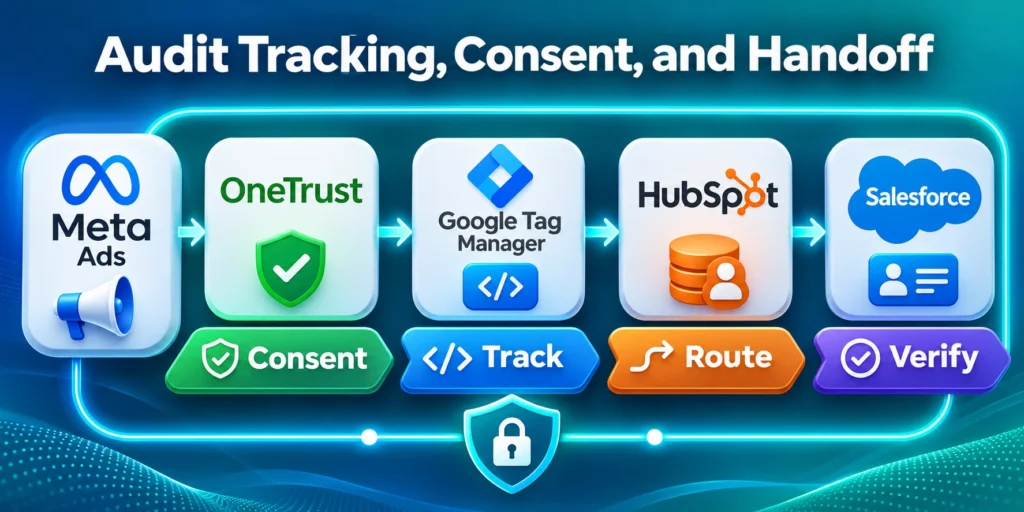
Map every event from ad delivery through form submission, CRM creation, routing, follow-up, qualification, opportunity, and outcome. Assign a system and owner to each step.
Use consistent identifiers where permitted, but do not assume platform reporting and CRM reporting describe the same event, time window, or person.
Verify Consent and Data Purpose
Explain what the reader receives and how information will be used. Keep optional marketing consent separate when applicable, and honor withdrawal through connected systems.
Limit audience uploads, form fields, enrichment, and retention to approved purposes. Document access and deletion routes before increasing campaign volume.
Confirm these consent controls before increasing volume:
- Test consent text on every form path.
- Verify suppression updates reach campaigns.
- Restrict exports and audience access.
- Document retention and deletion ownership.
Reconcile Attribution Gaps
Compare platform conversions with CRM records by date, campaign, offer, and status. Investigate missing records, duplicates, delayed imports, and inconsistent qualification definitions.
When appropriate matching is unavailable, interpret campaign and CRM trends together. Avoid false precision by assigning every influenced buyer to one attribution model.
Protect the Sales Handoff
Route leads with the asset, campaign context, stated problem, consent, and promised response. Avoid making sales repeat questions already answered on the form.
Monitor queue age, assignment failures, rejected records, response time, and reason codes. Fix operational leakage before judging the advertising audience.
Use a Controlled Scale Decision
Compare cost per qualified lead, opportunity progression, duplicate rate, follow-up speed, and sales feedback with the agreed baseline and alternative channels.
Scale only after quality remains stable across enough delivery. If volume rises while acceptance falls, pause the affected segment and revise the hypothesis.
Apply these safeguards before scaling the campaign:
- Keep budget and audience changes separate.
- Record every material test change.
- Allow outcomes time to mature.
- Stop when safeguards fail.
FAQ
These answers clarify how Meta Ads can distribute B2B content while teams protect consent, measurement quality, lead trust, and controlled commercial learning.
Is Meta Ads the same as B2B content syndication?
No. Meta Ads is paid social distribution. Traditional syndication usually uses a publisher or partner to distribute content and supply contacts under agreed criteria.
Can Meta Ads generate B2B leads?
It can generate responses, but quality depends on audience, offer, form, consent, CRM qualification, and follow-up. Test outcomes instead of equating volume with pipeline.
Should I use an instant form or a landing page?
Test the destination that supports the offer. Instant forms reduce steps; landing pages explain more and support on-site measurement. Compare qualified outcomes.
What should I optimize for?
Choose an event aligned with the campaign goal and available data. Connect qualified CRM stages when possible, and verify event volume and implementation.
How much budget do I need to test?
There is no universal minimum. Set a cap from acceptable test loss and likely conversion volume; a narrow test may still be inconclusive.
When should I stop a campaign?
Pause when the cap is reached, tracking fails, the offer misleads, or qualified outcomes remain below the agreed threshold after the evaluation window.
Should Meta Ads replace specialist B2B channels?
No. Test Meta as one distribution route and compare qualified outcomes with search, LinkedIn, partners, email, communities, and direct outreach.
How should campaigns exclude existing customers?
Use approved first-party audiences, maintain suppression updates, limit data use by purpose, and verify exclusions. Preserve customer communication through the appropriate owned channel.
Which content format works best for syndication?
Choose the format that supports the reader’s decision and can be consumed easily. Test the offer with the intended role instead of assuming one format wins.
How can a team reduce low-quality form fills?
Tighten the audience and offer, explain the asset clearly, request decision-relevant fields, validate routing, and review rejection reasons with sales.
Conclusion

Meta Ads can support B2B content syndication when the campaign distributes a useful asset to a testable audience and connects responses to mature CRM outcomes.
It should not be judged by cheap form fills alone. The decision depends on qualification, consent, follow-up reliability, opportunity progress, and comparable channel economics.
Use one controlled learning loop
Begin with a defined audience problem and one credible asset. Keep the destination, measurement plan, sales handoff, safeguards, and decision window visible to every owner.
Compare campaign cohorts after outcomes mature. Correct the weakest stage before expanding spend, and preserve rejection reasons so the next test starts with better evidence.
Use this sequence for every syndication cycle:
- Define one audience and decision problem
- Offer one genuinely useful asset
- Test one conversion path fairly
- Validate consent and CRM handoff
- Review sales-qualified outcomes before scaling
Scale only verified value
Increase budget when quality remains stable across additional delivery, sales accepts the resulting prospects, and measurement gaps cannot explain the apparent improvement.
Revise or stop when the asset attracts poor-fit demand, safeguards fail, or mature opportunity economics remain inferior to available alternatives.
Preserve evidence for the next test
Keep audience definitions, creative versions, destination details, consent language, CRM mappings, rejection reasons, and mature outcomes together in the experiment record.
That record prevents repeated mistakes and supports a stronger next hypothesis. It also shows whether performance changed because of media, process, or measurement.





Leave a Reply