


Project Scope Cost Drivers

There is no universal 2026 price for a custom web application. A focused internal workflow and a regulated multi-tenant platform are different products.
The amounts below are illustrative arithmetic, not observed market prices. They assume a hypothetical blended loaded rate of $100 per delivery hour.
Key considerations for project scope cost drivers include:
- Focused tool: 250–800 hours ($25,000–$80,000) for narrow workflows and few integrations.
- Customer portal: 800–2,500 hours ($80,000–$250,000) as payments or integrations expand.
- Multi-team platform: over 2,500 hours ($250,000+) when products, controls, or integrations expand scope.
These examples exclude tax, licenses, infrastructure, and post-launch operations. Real effort and loaded rates vary by team, geography, and delivery model.
Build a First Estimate from Scope
Define outcomes, workflows, integrations, migration, security, and launch boundaries before estimating effort by phase. Use those requirements to compare custom application development proposals.
For architectural scope and launch planning, use the site’s B2B web application development guide as the companion reference.
What Changes the Estimate
Feature count is only a rough proxy. A single feature can be inexpensive or costly depending on data, permissions, exceptions, and the systems it must connect.
Estimate each driver independently before combining them. This makes assumptions visible and helps teams reduce cost without removing essential controls.
Scope and workflow complexity
Count user roles, workflows, states, approvals, and exception paths. A workflow with manual review, retries, audit history, and role-based approvals needs more design and testing.
Separate the smallest useful release from later capabilities. Avoid funding speculative features before users validate the core workflow.
Integrations and data
For each integration, document the system owner, interface, authentication, data direction, frequency, rate limits, failure behavior, and test environment.
Migration cost depends on data quality, volume, mapping, duplicate handling, and downtime limits. Include rehearsal, reconciliation, and rollback plans.
Security, reliability, and compliance
Requirements such as single sign-on, audit trails, encryption, data residency, penetration testing, or recovery targets add implementation and evidence work.
Make the requirement concrete. “Secure” is not estimable; an access model, recovery objective, or required control can be scoped and tested.
Design, accessibility, and performance
Custom workflows, multiple device classes, localization, accessibility, and performance targets affect design, front-end engineering, and quality assurance.
Reuse established patterns where they fit. Bespoke interactions should solve a documented user problem rather than add novelty.
Cost Estimate Work Breakdown

A useful estimate starts with outcomes and work packages, not a single guessed total. Tie every amount to an assumption, deliverable, and owner.
Model discovery, design, engineering, integration, testing, deployment, and handover separately. Keep contingency visible instead of hiding it inside hourly rates.
Follow this sequence to cost estimate work breakdown:
- Write the scope boundary. Define users, workflows, browsers, external systems, migration, and explicit exclusions.
- Break work into deliverables. Include requirements, prototypes, architecture, implementation, testing, security, release, and training.
- Estimate by role and effort. Assign time to design, engineering, quality, management, and specialist review.
- Apply a loaded rate. Confirm the rate includes management, tools, taxes, travel, and vendor overhead.
- Add risk allowances. Separate known uncertainty from requested scope; revisit the allowance after discovery.
Translate effort into a budget
For example, a hypothetical 1,200-hour project at a blended $100 per hour produces $120,000 in labor before taxes, hosting, licenses, and contingency.
Keep each cost outside labor visible so stakeholders can compare delivery, operations, licenses, infrastructure, and risk allowances without double counting.
Review the Estimate Against Its Assumptions
This is arithmetic, not a market benchmark. If a proposal uses different rates or effort, compare the scope and role mix before comparing totals.
Document the assumptions with the team that owns the product. This makes later changes easier to price and approve.
Custom Development Team Models
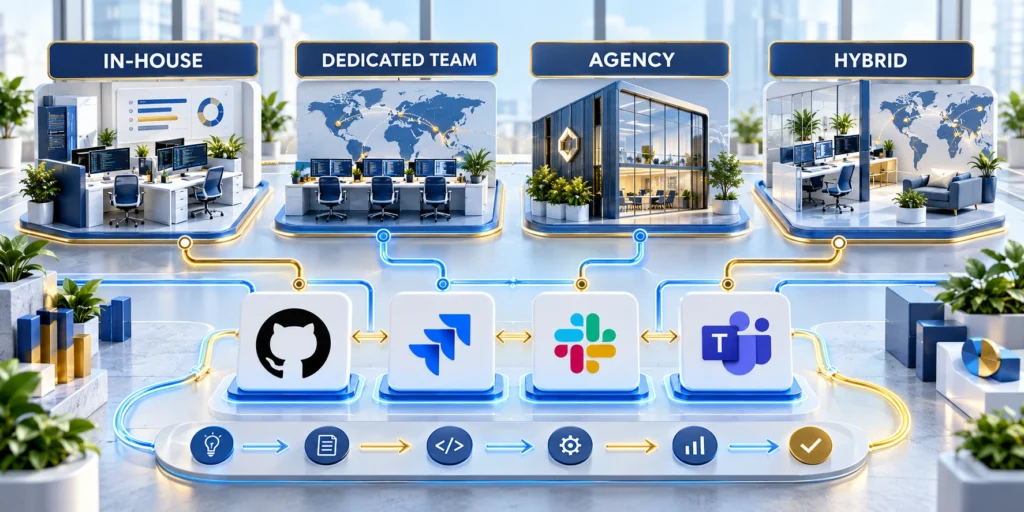
Compare skills, decision speed, continuity, and responsibility alongside fees. If you consider a nearshore development team, include its handoff and support commitments in the estimate.
A lower hourly rate does not guarantee a lower project cost. Communication, review, rework, and context transfer consume real delivery time.
Key considerations for custom development team models include:
- In-house team: offers close product context and continuity but requires recruiting time and payroll capacity.
- Agency or specialist partner: assembles experienced roles quickly but requires ownership, handover, and change control.
- Hybrid team: pairs internal knowledge with external capacity but needs a decision-maker and shared practices.
- Dedicated team: provides stable capacity but needs product direction and measurable delivery boundaries.
- Staff augmentation: fills skill gaps while internal leaders retain architecture and acceptance ownership.
- Fixed-scope delivery: suits defined outcomes but requires explicit assumptions and change handling.
- Managed service: combines delivery and support when responsibilities and service levels remain clear.
- Fractional specialists: add security, accessibility, or architecture review without permanent staffing.
Compare team models using these ownership controls:
- Identify who approves product and architecture decisions.
- Confirm access, documentation, and handover obligations.
- Define support ownership after the initial release.
Ask each provider to identify named roles, weekly availability, dependencies, and client responsibilities. Request examples of deliverables, not unsupported claims of guaranteed results.
For the broader build lifecycle, see the guide to SaaS product development from MVP to scale.
Total Cost of Ownership
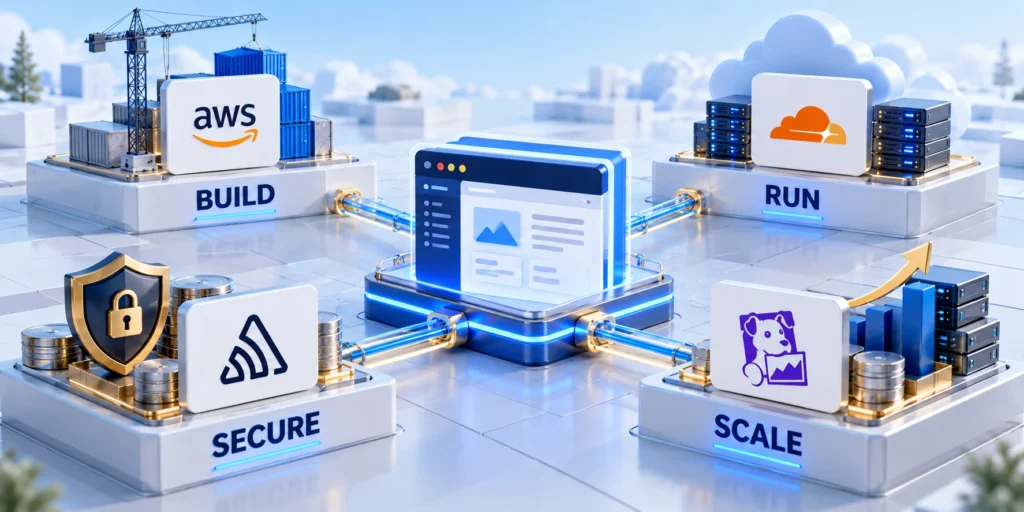
The launch invoice is only one part of the cost. A business application needs operations, support, security maintenance, and product ownership after release. These obligations continue when feature delivery slows.
Build a three-year view when comparing options. A cheaper initial build can cost more when maintenance, hosting, and change requests are omitted. Include planned upgrades, migrations, and audits.
Key considerations for total cost of ownership include:
- Cloud hosting, database, storage, backups, monitoring, and network transfer.
- Security updates, dependency maintenance, vulnerability response, and periodic review.
- Incident support, service-level commitments, observability, and disaster recovery tests.
- Third-party licenses, payment fees, email, analytics, identity, and integration services.
- Internal product ownership, user support, training, and future feature work.
- Accessibility regression testing and remediation after interface changes.
- Data retention, privacy requests, and audit evidence maintenance.
- Certificate, credential, domain, and integration renewal work.
- Vendor deprecations, API changes, and migration planning.
- Capacity planning for growth, regions, and availability targets.
Model these recurring cost triggers separately:
- Usage growth changes infrastructure and service tiers.
- Security findings create urgent remediation work.
- Product changes require testing, training, and support.
- Planned audits create evidence and remediation costs.
Estimate infrastructure using workload assumptions: users, requests, storage, traffic, region, redundancy, retention, and expected growth.
Cloud calculators help model those inputs, but their estimates are not a complete application budget. Validate the resulting services and usage assumptions with an engineer.
Evaluate Custom App Quote
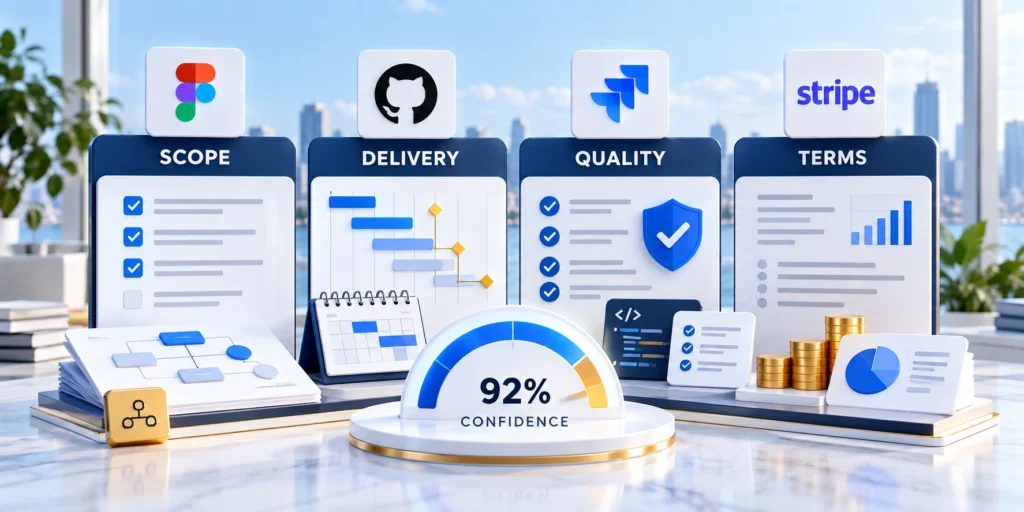
Normalize proposals before choosing a supplier. Ask every bidder to price the same scope, assumptions, acceptance criteria, and change process.
Check whether the proposal includes discovery, design, testing, security, deployment, documentation, training, and post-launch support.
Questions to ask
Use these questions to guide the final decision:
- Which requirements and integrations are included, and which are assumptions?
- What deliverables define acceptance for each milestone?
- Who owns source code, cloud accounts, domains, and credentials?
- How are change requests estimated, approved, and scheduled?
- What warranty, support response, and maintenance plan are included?
- What risks could change cost or timeline, and when will they be reassessed?
Ask for a short discovery phase when requirements remain uncertain. The output should be a reviewed scope, architecture, delivery plan, and revised estimate.
Compare proposals by total expected cost, evidence, and risk allocation. Avoid selecting the lowest number when its exclusions make the comparison misleading.
Scope worksheet for the first estimate
Before requesting bids, prepare one short worksheet. It reduces interpretation differences between stakeholders and suppliers.
Key considerations for scope worksheet for the first include:
- List user groups and the decisions each role must make.
- Map the current workflow, including exceptions and manual approvals.
- Name every system that sends or receives data.
- Describe records to migrate, their volume, quality, and retention rules.
- Set browser, accessibility, performance, security, and recovery expectations.
- Define who accepts the work and what evidence they need.
Mark each requirement as launch-critical, useful soon, or unvalidated. Only launch-critical items belong in the initial estimate unless dependencies require otherwise.
Ask product, operations, security, and finance owners to review the worksheet. Conflicting assumptions discovered early are cheaper to resolve than after implementation.
Worked planning example
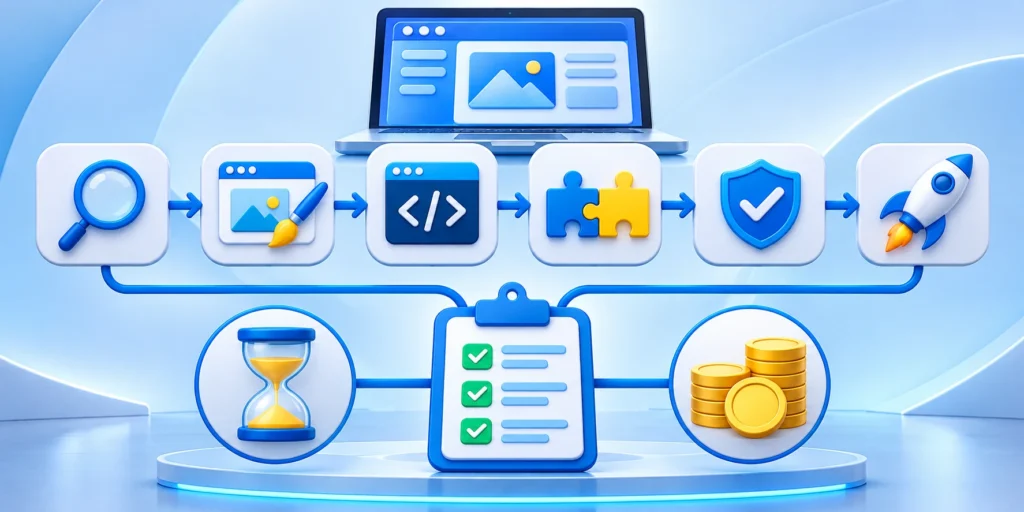
Imagine a B2B service company replacing emailed requests with a customer portal. Its first release supports account access, request submission, status updates, and an internal review queue.
The scope excludes payment processing, mobile apps, advanced analytics, and automated legacy-data cleanup. Those exclusions prevent a narrow portal estimate from absorbing unrelated work.
Calculate a Transparent Scenario
Suppose the team estimates discovery at 100 hours, design at 120, implementation at 650, integration at 180, testing at 220, and delivery management at 130.
The total is 1,400 hours. At a hypothetical blended rate of $100 per hour, labor totals $140,000 before contingency and operating costs.
| Phase | Hours | Labor at $100/hour |
|---|---|---|
| Discovery | 100 | $10,000 |
| Design | 120 | $12,000 |
| Implementation | 650 | $65,000 |
| Integration | 180 | $18,000 |
| Testing | 220 | $22,000 |
| Delivery management | 130 | $13,000 |
Adjust the Estimate When Scope Changes
If the business adds three complex integrations and data migration, the estimate must change. The team should revise affected work packages instead of applying an unexplained percentage.
Present a range when requirements remain uncertain. For example, show a base estimate and a separately explained risk allowance tied to unresolved integration behavior.
Explain What the Example Represents
This model is not a market quote. It demonstrates how transparent assumptions convert effort into a budget that stakeholders can challenge.
Changing the rate, scope, role mix, contingency, or operating model changes the result, so every comparison must retain the underlying assumptions.
Review the example using these decision checks:
- Confirm every phase has a defined output.
- Connect hours to named delivery roles.
- Keep contingency outside the base estimate.
- Separate labor from licenses and infrastructure.
- Re-estimate after material scope changes.
Reduce cost while preserving essential quality
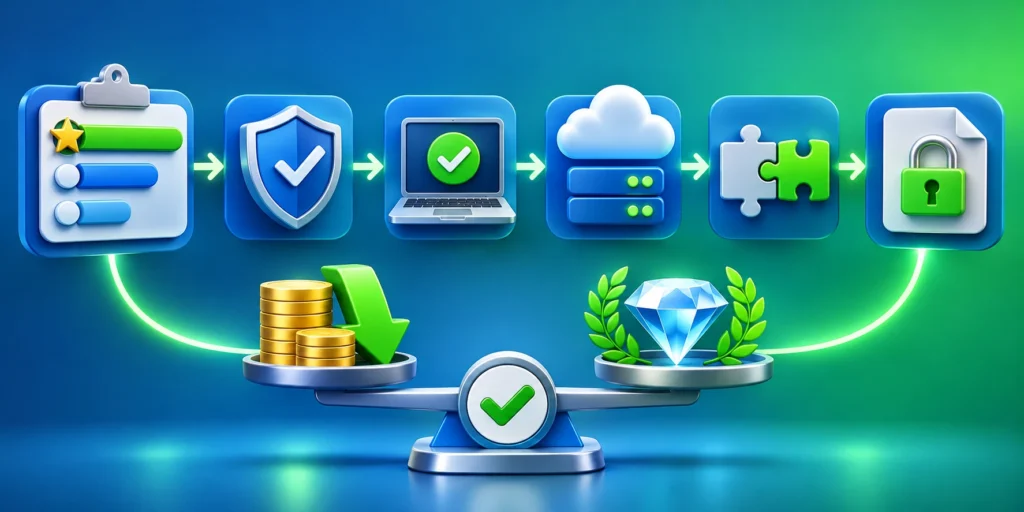
Cost control works best when teams reduce uncertainty or defer low-value work. Removing testing or security tasks usually transfers cost into operational risk. Defects interrupt users and demand unplanned support.
Prioritize complete, measurable workflows and standard capabilities before paying for broad customization that users have not validated. A smaller coherent release informs the next investment decision with measured evidence.
Use these actions to reduce cost while preserving essential quality:
- Prototype the riskiest user workflow before building every screen.
- Deliver one complete workflow first, then measure adoption and support needs.
- Use managed services when their operating model fits the organization.
- Prefer standard integrations over custom connectors when data and controls permit.
- Automate repeatable regression tests for critical business paths before every release.
- Keep exclusions and deferred features in a visible backlog.
- Reuse proven design patterns where they meet user needs.
- Validate data quality before pricing migration automation.
- Limit environments and regions to demonstrated requirements.
- Measure adoption before expanding low-value capabilities.
Protect ownership while reducing scope
Do not reduce cost by leaving ownership unclear. The organization still needs access to source code, deployment credentials, documentation, and recovery procedures. These assets prevent vendor dependency and support transitions.
When scope changes, ask which acceptance criteria, effort, and risks change. Approve the tradeoff before work begins. Document the revised baseline for finance, product, and delivery teams.
Plan discovery when estimates are still wide
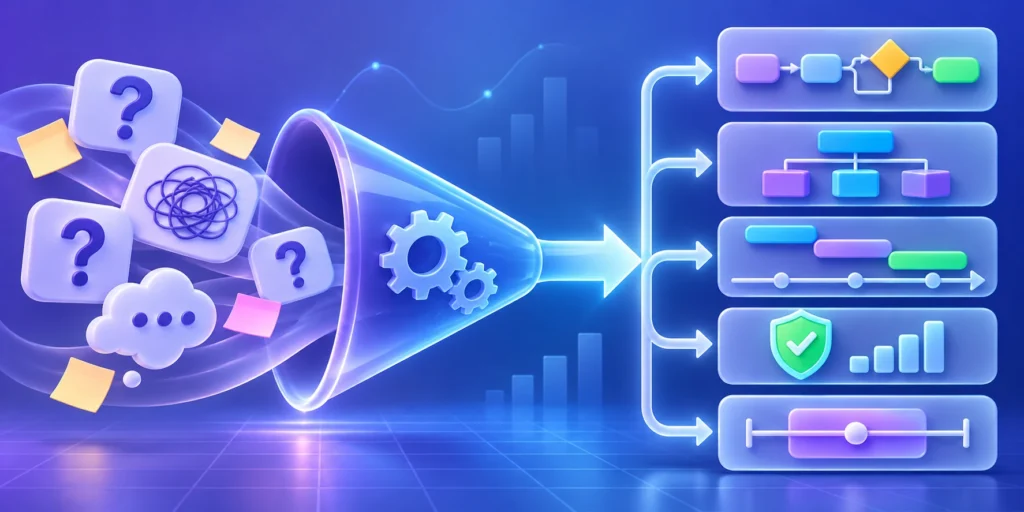
A discovery phase is useful when different teams interpret the problem differently or integrations lack reliable documentation.
Set a timebox and require concrete outputs: workflow maps, prioritized requirements, technical risks, data assumptions, delivery milestones, and a revised estimate.
Require these outputs from focused discovery:
- Prioritized workflows with accountable business owners.
- Integration and data assumptions with evidence.
- Technical risks requiring prototype validation.
- Acceptance criteria for the first release.
- A revised roadmap and estimate range.
Use Discovery to Support a Decision
Discovery should reduce a specific uncertainty. Avoid open-ended analysis that produces documents without improving a build decision.
At the end, decide whether to build, buy, integrate an existing product, or stop. A well-supported decision can save more than an early low quote.
Define the discovery commercial boundary
A discovery agreement should define duration, participants, deliverables, review dates, ownership, and the decision it must enable. This prevents preliminary analysis from becoming an indefinite engagement.
Price discovery separately from implementation and state which evidence may change the estimate. The build proposal should reference approved findings instead of silently replacing earlier assumptions.
Confirm these boundaries before discovery work begins:
- Name the executive and operational decision owners.
- Schedule access to users, systems, and documentation.
- Define acceptance criteria for every discovery deliverable.
- Record unresolved risks with owners and deadlines.
- Specify how findings update scope, price, and schedule.
- Define security and procurement constraints before solution selection.
Make cost assumptions visible

A credible custom application estimate shows the assumptions behind the number. Scope, integrations, roles, security requirements, data migration, and delivery constraints can materially change the effort.
Ask vendors to state what is included, excluded, uncertain, and dependent on discovery. This gives decision makers a clearer basis for comparing proposals than one headline price.
Use these actions to make cost assumptions visible:
- List expected users, regions, roles, and peak usage assumptions.
- Identify integrations, data sources, and external platform dependencies.
- Separate required capabilities from optional future enhancements.
- State security, compliance, accessibility, and support expectations.
Use discovery to reduce expensive uncertainty
Discovery is not extra documentation. It reduces uncertainty before design and development decisions become costly to reverse, especially when legacy processes or data shape the solution.
A useful discovery phase produces prioritized workflows, technical constraints, a delivery sequence, acceptance criteria, and a transparent estimate range. It also reveals where a simpler approach can meet the goal.
Follow this sequence to use discovery to reduce expensive uncertainty:
- Validate valuable user journeys first.
- Map systems, data ownership, and integration responsibilities.
- Identify risks requiring proof-of-concept work.
- Split the roadmap into releasable, measurable increments.
- Review the estimate after decisions reduce uncertainty.
Compare proposals beyond the initial build
Low initial cost can create higher operating cost when a proposal omits testing, documentation, security maintenance, monitoring, ownership transfer, or the capacity to support the application after launch.
Compare the operating model as carefully as the build plan. A stronger proposal explains governance, quality controls, change management, knowledge transfer, and responsibilities that remain with the client.
Use these actions to compare proposals beyond the initial build:
- Check how scope changes are estimated and approved.
- Confirm code ownership, documentation, and access handover.
- Review testing, deployment, monitoring, and support coverage.
- Ask how the team will measure whether the release solved the problem.
Conclusion
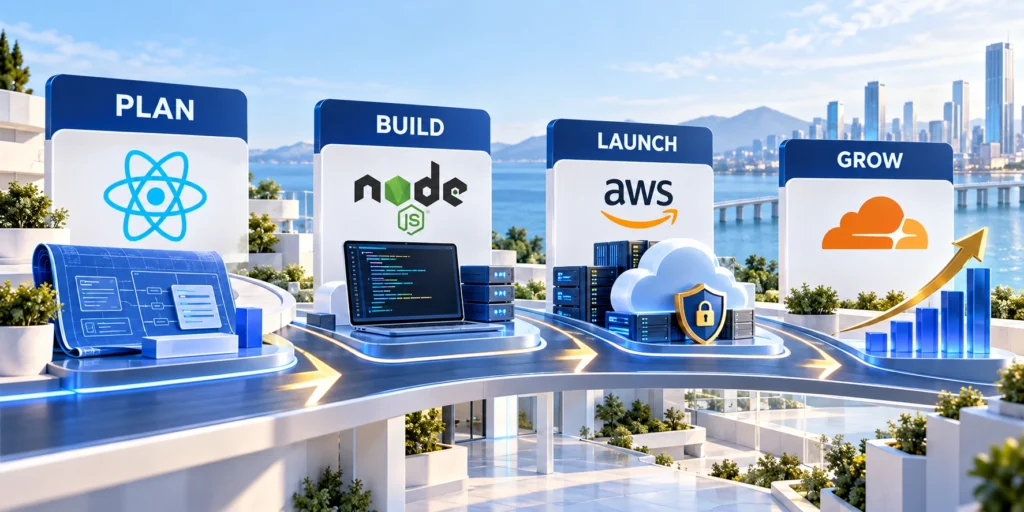
Custom web application cost in 2026 is best treated as a scoped estimate, not a universal price list. The right number depends on work and ownership.
Define a useful first release, price its full delivery, and model support after launch. Then compare proposals against the same assumptions and acceptance criteria.
Plan integration costs explicitly
For integration scope, authentication, data exchange, and operational risks, use the custom API and third-party integrations playbook.
Integration estimates should separate initial connection work from the cost of operating that connection after launch. Both affect the application budget and delivery risk.
Use these actions to plan integration costs explicitly:
- Document the external system owner and available support channel.
- Confirm authentication, permissions, quotas, and test-environment access.
- Estimate mapping, validation, retries, reconciliation, and failure alerts.
- Include vendor changes, version upgrades, and credential rotation.
- Assign responsibility for incidents and disputed data.
Include the operating cost of integrations
A connector is not finished when the first request succeeds. Teams must monitor failures, renew credentials, review provider changes, and investigate records that do not reconcile.
Estimate those responsibilities as recurring work. Name the internal owner, support provider, response expectation, and evidence needed to confirm that synchronized data remains complete.
Use these actions to include the operating cost of integrations:
- Monitoring and alert response.
- Provider release and deprecation reviews.
- Credential and permission maintenance.
- Failed-record replay and reconciliation.
- Periodic security and privacy review.
Price integration uncertainty transparently
Unclear documentation, unavailable sandboxes, inconsistent identifiers, and undocumented business rules create uncertainty. A single fixed number can conceal that risk instead of managing it.
Use a bounded discovery task when the interface cannot be verified before estimating. The output should identify supported operations, sample payloads, limits, exceptions, and remaining unknowns.
Compare a base case with a risk case
A base estimate can assume documented endpoints, stable identifiers, representative test data, and timely vendor support. Record each assumption beside the related work package.
A risk case should show the effort added by data cleanup, custom reconciliation, missing test access, or manual fallback procedures. Keep that allowance separate and explainable.
Follow this sequence to compare a base case with a:
- Verify the interface and data ownership.
- Estimate the supported path first.
- List unresolved assumptions and their impact.
- Price discovery or contingency separately.
- Re-estimate after evidence reduces uncertainty.
This approach lets decision makers compare proposals without treating every uncertainty as guaranteed work. It also prevents a low headline price from hiding predictable integration obligations.
Reserve budget for controlled change
External platforms change independently of the application roadmap. A provider can retire an endpoint, change a permission model, reduce a quota, or require a new authentication flow.
Include a modest maintenance allowance tied to actual review triggers. This is more transparent than embedding an unexplained percentage in the initial build estimate.
Key considerations for reserve budget for controlled change include:
- Review announced provider changes.
- Test upgrades against representative records.
- Update monitoring and recovery procedures.
- Document decisions and revised ownership.
When no change is required, the allowance should remain visible rather than being treated as automatically spent. When action is required, the trigger provides evidence for prioritization.
For procurement, ask each supplier to distinguish implementation, recurring support, third-party charges, and optional improvement work. That separation makes proposals easier to compare over several years.
FAQ
These answers summarize cost ranges, schedules, exclusions, contingency, discovery, proposal comparison, estimate formats, and post-launch ownership for custom applications.
How much does a custom web application cost in 2026?
A focused internal tool may fit a tens-of-thousands budget. Portals and multi-team platforms often require substantially more effort.
Use the planning bands above only to set an initial range. A scoped estimate needs workflows, integrations, data, and quality requirements.
How long does a custom web application take?
Timeline depends on scope, team availability, approvals, and external dependencies. A focused first release may take weeks; broader platforms can take months.
Ask for milestones, decision dates, and critical dependencies. A calendar estimate without these assumptions is difficult to rely on.
What is usually excluded from a development quote?
Common exclusions include cloud usage, third-party licenses, migration cleanup, taxes, extensive content entry, and support after the warranty period.
Ask for exclusions in writing and assign each one an owner and a budget line.
Is custom software cheaper than SaaS?
Not automatically. SaaS reduces initial build effort but adds recurring fees and may require process compromises or integration work.
Compare several years of subscription, implementation, customization, and switching costs against build and ownership expenses.
How much contingency should a project include?
Set contingency from identified risks and uncertainty. A discovery phase can reduce unknowns before a team commits to a fixed delivery scope.
Track contingency separately and define who may authorize its use.
Should a discovery phase have a fixed price?
It can, when the timebox, participants, questions, and deliverables are explicit. The purpose is to reduce uncertainty before committing to broader delivery.
Require a reviewed scope, technical risks, delivery options, and revised estimate rather than an open-ended research engagement.
What information is needed before requesting an estimate?
Provide user groups, important workflows, integrations, data migration needs, security obligations, expected usage, launch priorities, and known exclusions.
When information is missing, label the assumption and explain how resolving it could change effort, sequence, or risk.
How should businesses compare agency proposals?
Normalize scope, roles, assumptions, acceptance criteria, ownership, support, and exclusions. Then compare total expected cost and risk allocation.
A lower headline price is not equivalent when testing, documentation, security, deployment, or post-launch responsibilities are omitted.
When is a cost range better than a fixed estimate?
Use a range when material requirements, integrations, or data conditions remain unverified. Tie both limits to named assumptions and evidence.
Replace the range with a narrower estimate after discovery validates the riskiest workflows and dependencies.
Which post-launch costs belong in the budget?
Include hosting, monitoring, backups, security maintenance, support, third-party services, incident response, training, and planned product changes.
Assign an owner and review trigger to each recurring cost so the operating model remains visible after launch.




Leave a Reply