


Define Nearshore and Offshore Delivery
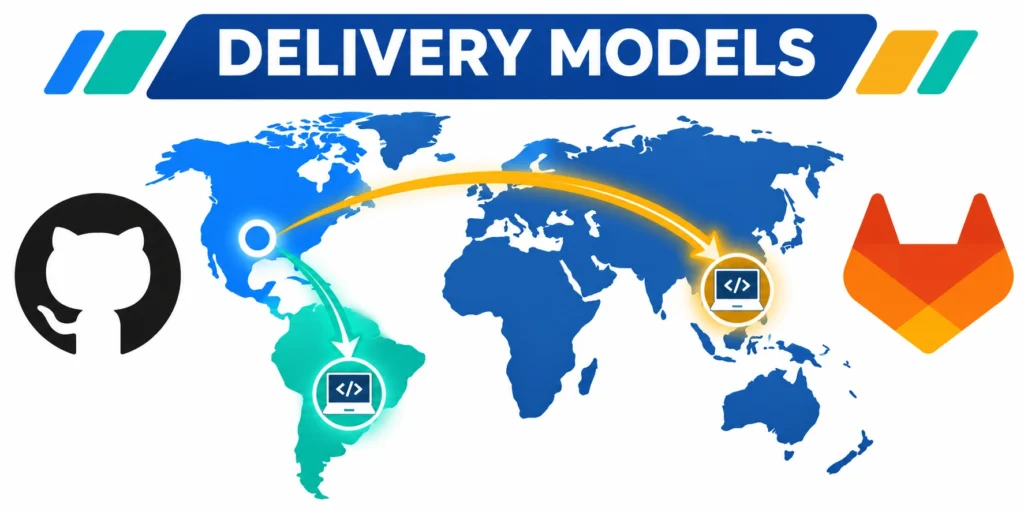
Nearshore vs offshore software development compares delivery teams located at different distances from the client. Geography affects overlap, travel, communication, and talent access.
Nearshore teams typically operate in nearby countries, while offshore teams work from distant regions. Neither label defines scope, accountability, quality, or commercial structure.
Separate geography from operating responsibility
A nearshore engagement may use staff augmentation, a dedicated product team, or managed delivery. An offshore engagement can use the same structures with different collaboration patterns.
Define who owns product decisions, architecture, engineering, testing, releases, operations, and vendor coordination before treating location as a meaningful selection criterion.
Use these actions to separate geography from operating responsibility:
- Client and provider locations
- Engagement and pricing structure
- Product and engineering ownership
- Coverage and escalation commitments
- Knowledge and exit obligations
Client responsibility remains essential in every model. Business priorities, risk acceptance, data authority, and consequential product decisions cannot disappear through outsourcing.
Provider responsibility should be specific enough to evaluate. Named outcomes, deliverables, staffing, coverage, evidence, and escalation rules make proposals comparable.
Define the model before comparing providers
Avoid assuming nearshore always means Latin America or offshore always means Asia. The practical question is the relationship between client and delivery locations.
Measure usable overlap, travel practicality, language, infrastructure, legal terms, security, and labor stability for the exact countries and teams under consideration.
Use these actions to define the model before comparing providers:
- Name accountable decision owners
- Normalize provider responsibilities
- Measure actual working overlap
- Confirm proposed delivery locations
- Document critical operating assumptions
A precise definition prevents buyers from comparing hourly rates attached to completely different responsibilities, seniority, tooling, governance, and transition obligations.
The comparison should begin with the work and operating constraints, then identify which geographic arrangement supports the required delivery behavior.
Compare Time-Zone Overlap
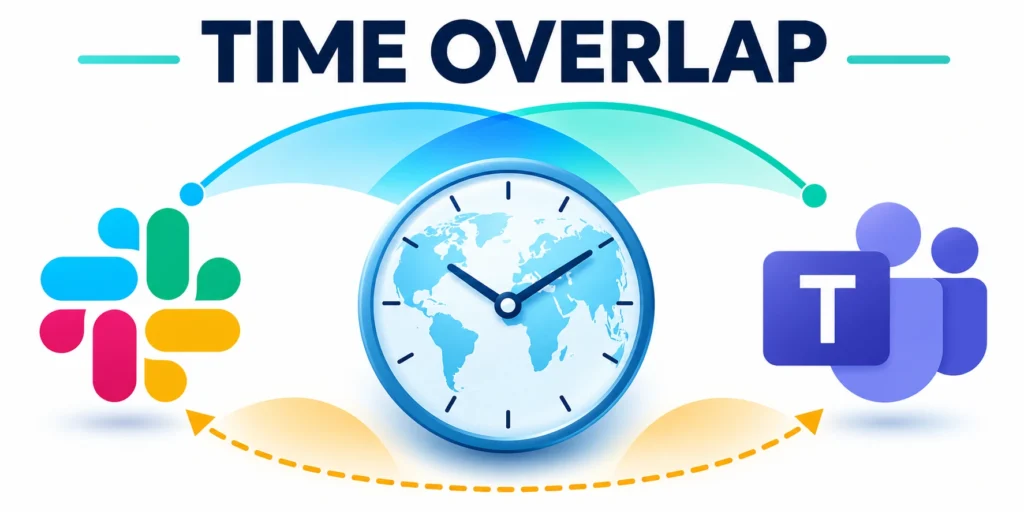
Time-zone overlap influences how quickly teams resolve ambiguity, coordinate releases, review architecture, investigate failures, and obtain product decisions during the working day.
Nearshore teams often share several daytime hours with United States clients. Offshore teams may provide shorter overlap but longer follow-the-sun coverage.
Measure collaboration windows by activity
Map required collaboration by activity instead of selecting a universal meeting window. Product discovery needs more live discussion than independent implementation with stable requirements.
Incident response, critical releases, design reviews, backlog refinement, and user research may each need different combinations of shared time and asynchronous preparation.
Use these actions to measure collaboration windows by activity:
- Product and architecture discussions
- Backlog and acceptance decisions
- Critical release coordination
- Incident and escalation response
- Customer and stakeholder updates
Calculate overlap using real locations, daylight-saving changes, holidays, and expected schedules. Country labels alone do not prove that proposed team members share working hours.
Protect concentrated work by assigning predictable collaboration windows. Constant meetings can eliminate the productivity advantage that overlap was intended to create.
Use asynchronous work deliberately
Offshore handoffs can accelerate continuous delivery when work is modular, evidence is complete, and the receiving team has authority to proceed without waiting.
Handoffs fail when context remains in conversations, acceptance criteria are unclear, or dependencies require a decision from an unavailable stakeholder.
Apply these criteria to asynchronous work deliberately:
- Record active work and blockers
- Name the next action owner
- Attach evidence and decisions
- Confirm the next response time
- Require receiver acknowledgment
Test the schedule with representative work before committing broadly. Observe decision latency, meeting load, handoff quality, incident escalation, and unresolved waiting time.
Choose the smallest coverage design that protects business risk while maintaining sustainable schedules, access to expertise, and reliable decision authority.
Evaluate Communication and Collaboration
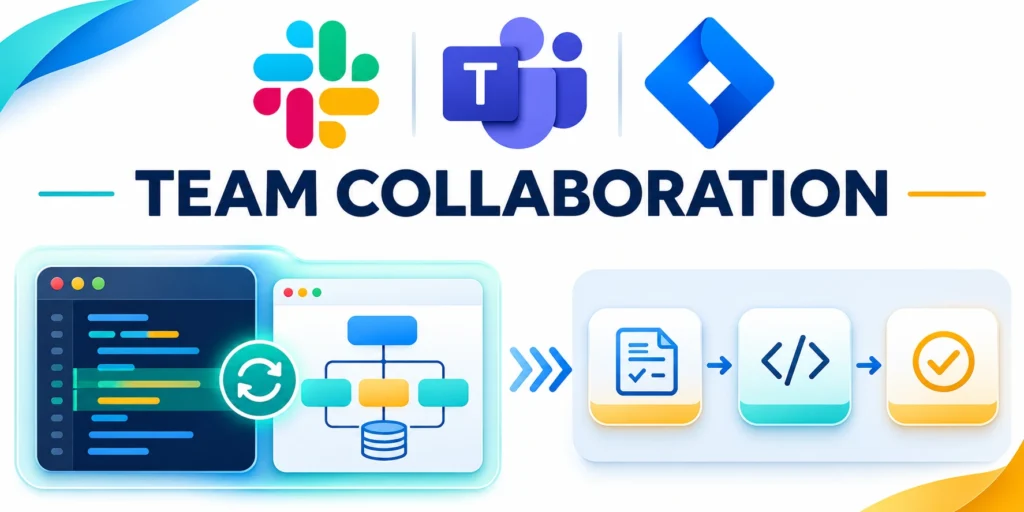
Effective collaboration depends on clarity, listening, documentation, technical judgment, and psychological safety. Physical proximity cannot compensate for weak operating habits or unclear authority.
Nearshore overlap supports live workshops and rapid clarification. Offshore delivery can succeed through disciplined written communication, planned overlap, and clearly bounded decisions.
Test communication through real technical work
Evaluate proposed team members, not only sales representatives. Use a working session involving requirements, architecture, tradeoffs, uncertainty, and a realistic change in direction.
Observe whether participants ask useful questions, explain assumptions, identify risk, challenge unsafe requests, and convert discussion into precise actions and records.
Use these actions to test communication through real technical work:
- Architecture and requirement workshop
- Written design and decision record
- Code review and feedback sample
- Incident coordination simulation
- Changed-priority planning exercise
Assess written communication through actual artifacts: user stories, designs, pull requests, test evidence, incident notes, release plans, and decision logs.
Fluent speech is helpful but insufficient. Technical communication must preserve meaning across product, engineering, quality, security, and executive audiences.
Build one shared delivery record
Use shared repositories, issue tracking, architecture records, and accessible meeting summaries. Private messages should not become the authoritative source for delivery decisions.
Define response expectations by urgency and channel. Immediate messaging for every question creates interruption, while email-only coordination can slow urgent decisions.
Use these actions to build one shared delivery record:
- Use one issue system
- Record important decisions
- Link code and acceptance evidence
- Publish escalation channels
- Review communication-caused rework
Track rework caused by misunderstood requirements, delayed answers, incomplete handoffs, and conflicting decisions. These costs reveal collaboration quality more accurately than meeting attendance.
The strongest model combines enough real-time access for complex decisions with enough written discipline to preserve knowledge and support independent progress.
Build the Full Cost Model
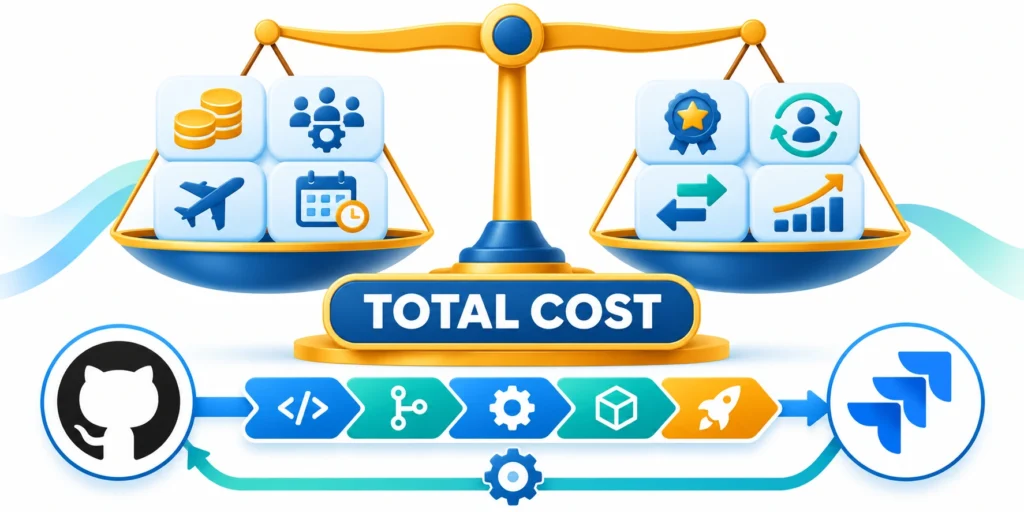
Hourly rates are visible, but they rarely represent the complete economic difference between nearshore and offshore software development. Delivery behavior changes total cost materially.
Include staffing, management, onboarding, tools, travel, communication, quality, delay, turnover, transition, retained client roles, and the business consequences of failure.
Move beyond hourly rate comparisons
Normalize role definitions and seniority before comparing rates. A senior engineer with architectural responsibility is not equivalent to a narrowly scoped implementation resource.
Compare productive capacity rather than paid hours. Waiting for decisions, repeated clarification, avoidable rework, and excessive coordination reduce usable delivery output.
Key considerations for move beyond hourly rate comparisons include:
- Provider labor and leadership
- Client management and decision effort
- Tools, travel, and infrastructure
- Quality and support consequences
- Transition and exit obligations
Estimate internal management demand for product ownership, architecture, vendor governance, security, finance, procurement, and executive escalation under each model.
A lower provider rate can still create higher total cost when the client must add several internal coordinators or repeatedly correct incomplete work.
Model uncertainty and business impact
Model quality through defect escape, failed changes, support demand, recovery effort, and maintainability. Software cost continues after the initial delivery period.
Include transition and exit scenarios. Knowledge reconstruction, access recovery, provider replacement, and unfinished commitments can dominate late-stage economics.
Use these actions to model uncertainty and business impact:
- Compare equivalent role scope
- Estimate usable delivery capacity
- Model delay and rework
- Price continuity and replacement
- Test optimistic and adverse cases
| Cost area | Nearshore tendency | Offshore tendency |
|---|---|---|
| Collaboration | More shared workday | More asynchronous |
| Travel | Usually simpler | Usually more complex |
| Coverage | Regional overlap | Follow-the-sun options |
| Coordination | Lower time distance | Higher handoff demand |
Use ranges for uncertain inputs and test sensitivity to turnover, scope change, delay, travel, and defect rates. False precision weakens the decision.
Select the model with the best risk-adjusted business outcome, not the lowest optimistic estimate presented before real delivery evidence exists.
Compare Talent Access and Continuity

Global delivery expands access to software skills, but regional market size does not guarantee that a provider can supply the right team consistently.
Evaluate technology depth, product experience, domain context, communication, leadership, quality practices, and operational capability for the exact roles the engagement requires.
Evaluate the proposed team and talent system
Interview proposed delivery leaders and representative specialists. Confirm which people are committed, how allocation works, and whether substitutes may appear after contracting.
Use practical exercises to examine architecture, debugging, testing, code review, estimation, and tradeoff communication without turning the evaluation into unpaid project delivery.
Use these actions to evaluate the proposed team and talent:
- Relevant architecture experience
- Product and domain understanding
- Quality and operational judgment
- Communication and leadership ability
- Stable staffing and succession
Ask how the provider recruits, develops, promotes, retains, and replaces people. A strong talent system matters more than a temporary list of available resumes.
Review team stability, average tenure, leadership continuity, replacement timing, documentation expectations, and the client’s participation in staffing changes.
Protect knowledge from avoidable turnover
Concentrated knowledge creates risk in both nearshore and offshore models. Pair ownership, review work across teammates, and maintain accessible operational and architectural records.
Plan succession before departure. Shadowing, recorded decisions, runbooks, code stewardship, and overlapping transitions reduce disruption when personnel changes occur.
Use these actions to protect knowledge from avoidable turnover:
- Name primary and backup owners
- Review work across teammates
- Keep decisions in shared systems
- Require overlap during replacements
- Measure knowledge concentration risk
Balance specialization with maintainability. A rare expert may solve an immediate challenge while leaving the organization dependent on knowledge nobody else can use.
Choose a provider that can sustain required capability through normal turnover, growth, leave, and changing technology rather than only staffing the first month.
Plan Contracting and Knowledge Ownership

Cross-border contracts must translate the operating model into enforceable scope, responsibilities, access, ownership, security, payment, transition, and dispute terms for the specific jurisdictions involved.
Qualified legal, tax, privacy, and security professionals should review material obligations. A delivery provider should not decide the client’s regulatory responsibilities.
Make delivery assets portable from the start
Define ownership and access for source code, repositories, cloud accounts, domains, credentials, documentation, designs, data, models, tests, pipelines, and third-party subscriptions.
Client-controlled systems reduce transition risk, while provider-managed systems may simplify operations. The contract should explain export, transfer, retention, and deletion duties.
Use these actions to make delivery assets portable from the:
- Source code and repositories
- Cloud and delivery accounts
- Documentation and decision history
- Data and intellectual property
- Licenses and third-party services
- Transition and deletion evidence
Specify background intellectual property, newly created work, open-source components, licenses, reusable provider assets, and any restrictions affecting future maintenance or commercialization.
Require a current inventory of dependencies and licensing obligations. Hidden proprietary components can make an apparently portable application difficult to operate elsewhere.
Design a workable exit before signing
Knowledge ownership requires more than document delivery. Teams need usable architecture records, decision history, runbooks, setup instructions, release evidence, and known-risk inventories.
Define documentation quality, update cadence, acceptance, and access throughout the engagement. A rushed archive at termination rarely captures working knowledge adequately.
Use these actions to design a workable exit before signing:
- Keep client access current
- Export critical records regularly
- Test environment reconstruction
- Document open-source obligations
- Review exit readiness annually
Exit provisions should cover notice, transition assistance, team overlap, credential transfer, final releases, unresolved work, data return, deletion evidence, and reasonable cooperation.
Exercise portability periodically by onboarding a new contributor or recreating an environment from documented assets before dependence becomes difficult to reverse.
Design Delivery Governance
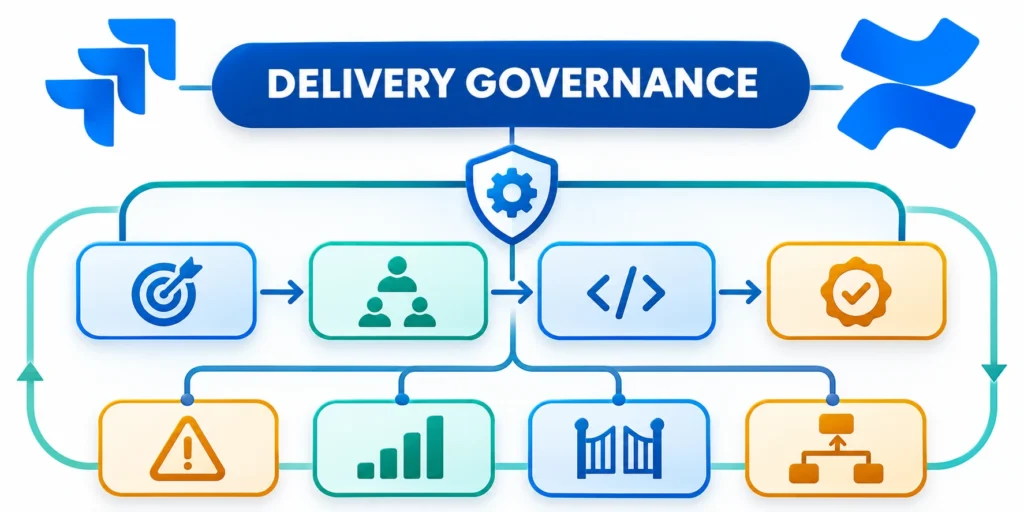
Delivery governance turns commercial intent into repeatable decisions. It defines who prioritizes, approves, executes, reviews, escalates, and accepts outcomes across organizational boundaries.
Nearshore overlap can support frequent live coordination, while offshore models may rely more heavily on planned decision windows. Both require explicit authority and evidence.
Connect authority, evidence, and cadence
Assign one accountable product owner and clear technical leadership. Committees can provide input, but they should not leave routine decisions without an owner.
Define responsibilities for backlog, architecture, security, quality, releases, operations, budget, vendors, incidents, and customer communication using practical scenarios.
Use these actions to connect authority evidence and cadence:
- Product priority and acceptance
- Architecture and technical standards
- Quality and release authority
- Security and operational risk
- Budget and commercial decisions
- Provider staffing and continuity
Set cadences by decision need: daily coordination, weekly delivery review, regular architecture and risk review, and periodic commercial and outcome governance.
Every meeting should consume prepared evidence, make decisions, assign actions, or resolve escalation. Status reporting alone should remain accessible asynchronously.
Escalate decisions without bypassing ownership
Use a shared scorecard covering outcomes, flow, predictability, quality, reliability, risk, team health, and knowledge. Avoid rewarding volume detached from customer value.
Metrics need stable definitions, sources, owners, and limitations. Changing calculations to improve reported performance destroys trust across both delivery models.
Key considerations for escalate decisions without bypassing ownership include:
- Publish decision rights
- Prepare evidence before reviews
- Track actions to closure
- Escalate defined thresholds
- Revisit governance after change
Create escalation thresholds for blocked decisions, budget variance, quality deterioration, security concerns, staffing changes, and repeated service failures.
Governance succeeds when ordinary work moves without executive intervention while consequential risks reach the correct decision maker early enough to act.
Protect Quality and Reliability
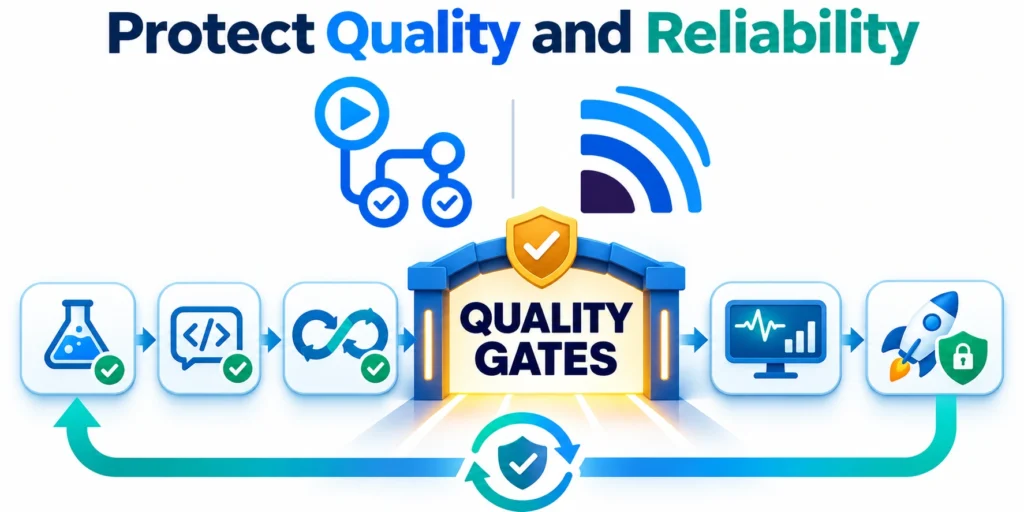
Quality depends on engineering practices, system design, incentives, and feedback, not whether developers are nearshore or offshore. Apply one verifiable standard across locations.
Define acceptance through observable behavior, tests, security controls, performance, accessibility, operability, documentation, and support readiness rather than subjective completion claims.
Use the same engineering evidence everywhere
Keep code in shared version control with review requirements, protected branches, automated tests, dependency checks, and reproducible pipelines controlled through approved access.
Require evidence for each release, including changes, tests, approvals, artifacts, deployment results, monitoring, known limitations, and a usable rollback path.
Apply these criteria to the same engineering evidence everywhere:
- Peer review and branch protection
- Automated functional test coverage
- Security and dependency checks
- Repeatable deployment and rollback
- Production monitoring and feedback
Design quality early through architecture, interface contracts, testability, observability, and failure handling. Final inspection cannot compensate for structural weaknesses discovered late.
Test representative customer journeys and operational conditions. Include data volume, concurrency, dependency failure, regional behavior, permissions, and recovery scenarios.
Connect delivery quality to production outcomes
Track escaped defects, failed changes, reopens, rollback frequency, incident recurrence, support demand, and maintainability alongside feature delivery and schedule performance.
Compare results using equivalent definitions. A team closing many tickets may still create higher downstream cost through rework, defects, or fragile architecture.
Use these actions to connect delivery quality to production outcomes:
- Measure escaped defects
- Review failed changes
- Track incident recurrence
- Improve tests after failures
- Prioritize reliability work visibly
Run blameless reviews after material failures and assign systemic improvements. Avoid using location as a convenient explanation when process, design, or leadership caused the outcome.
Reliable delivery emerges when both client and provider own prevention, evidence, recovery, and continuous improvement throughout the product lifecycle.
Choose the Model by Project Context
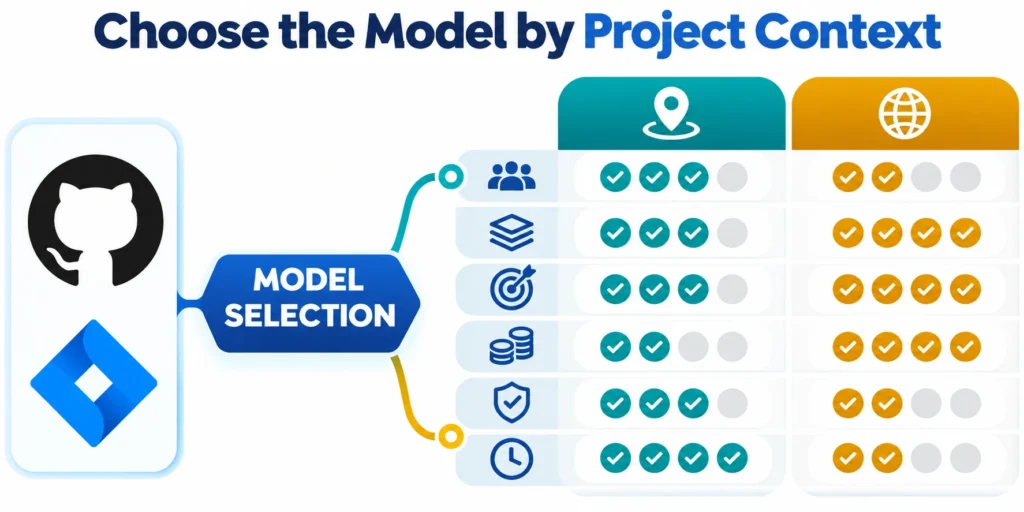
The preferred model depends on product uncertainty, business criticality, collaboration intensity, skill availability, delivery scale, security, budget, and the client’s management capability.
Nearshore commonly fits products needing frequent live collaboration and shared working hours. Offshore may fit scalable, specialized, or follow-the-sun work with strong specifications.
Match delivery design to uncertainty and risk
Early product discovery benefits from rapid access to users and decision makers. Mature platforms with modular backlogs may support more asynchronous execution.
Complex architecture and high operational risk require experienced leadership, reliable escalation, and close evidence review regardless of the team’s location.
Key considerations for match delivery design to uncertainty include:
- Product uncertainty and decision speed
- Architecture and operational risk
- Required collaboration intensity
- Specialist skill and scale needs
- Client management readiness
- Security and legal constraints
Assess internal readiness honestly. Staff augmentation needs strong client management, while managed delivery requires the client to define outcomes and govern provider accountability.
Consider hybrid arrangements when responsibilities differ. Product leadership and architecture may stay close while specialized implementation or extended coverage uses another region.
Pilot the operating model before broad scale
Avoid splitting tightly coupled work solely to capture rate differences. Coordination boundaries should follow architecture, ownership, and communication needs rather than procurement categories.
Score mandatory conditions first, then preferences. A model that cannot meet security, continuity, legal, or critical coverage requirements should not remain viable.
Key considerations for pilot the operating model before include:
- Choose representative pilot work
- Define baseline and success measures
- Include real decision owners
- Review quality and management effort
- Expand through evidence-based gates
Run a bounded pilot using representative complexity, real stakeholders, and production-like quality expectations. Measure collaboration, throughput, quality, predictability, and management effort.
The nearshore software development services framework can guide expansion after evidence validates collaboration, quality, management effort, access, staffing, and knowledge transfer.
Conclusion
Nearshore and offshore software development can both produce strong outcomes. Geography changes collaboration conditions, but it does not replace capability, ownership, governance, or engineering discipline.
Nearshore delivery often improves real-time access and travel practicality. Offshore delivery can broaden scale, specialization, and continuous coverage when asynchronous work is designed well.
Choose delivery behavior before geography
Define the work, decision rights, quality evidence, coverage, knowledge, and transition obligations before comparing providers or headline rates.
Evaluate proposed people and operating systems through real scenarios. Sales claims are weaker evidence than observed communication, technical judgment, and delivery artifacts.
Use these actions to choose delivery behavior before geography:
- Define ownership before location
- Compare full economic outcomes
- Test proposed teams directly
- Protect quality and knowledge
- Maintain practical exit options
Use total cost rather than labor rates. Include internal management, delay, rework, defects, turnover, tools, travel, support, transition, and business impact.
Protect portability through client access, shared systems, current documentation, transparent dependencies, and exit terms that can be exercised without rebuilding knowledge from zero.
Keep the model measurable and portable
A hybrid model can combine regional strengths when responsibilities remain coherent. Avoid creating coordination boundaries that fragment one tightly coupled product or service.
Govern outcomes through stable measures, explicit escalation, and regular review. Change the model when evidence shows that assumptions no longer match the service.
Use these actions to keep the model measurable and portable:
- Measure collaboration and delay
- Review defects and reliability
- Track continuity and turnover
- Reassess costs and assumptions
- Scale only after evidence
Begin with a representative pilot when uncertainty remains. It should test collaboration, quality, reliability, management demand, and knowledge transfer under realistic conditions.
The best choice is the delivery system that protects customer outcomes while sustaining capable teams, clear ownership, dependable software, and reversible business commitments.
FAQ
These answers summarize the practical differences between nearshore and offshore development across collaboration, cost, talent, ownership, quality, piloting, and operating-model change.
What is nearshore software development?
Nearshore software development uses a team in a nearby country or region, usually providing meaningful workday overlap, practical travel, and easier real-time collaboration.
What is offshore software development?
Offshore software development uses a team in a distant region, often providing broad talent access, scalable capacity, and asynchronous or follow-the-sun delivery.
Is nearshore development better than offshore?
Neither is universally better. The correct model depends on collaboration, scale, specialization, cost, risk, coverage, legal constraints, and the client’s operating capability.
Is nearshore software development cheaper?
Nearshore rates may differ from onshore and offshore rates, but total cost also includes management, delay, rework, quality, turnover, travel, support, and transition.
How much time-zone overlap is necessary?
Required overlap depends on the work. Discovery, architecture, incidents, and releases need more live access than stable, modular implementation with strong written evidence.
How should a company evaluate communication?
Use working sessions, written artifacts, design discussion, code review, changed priorities, and incident simulations with the proposed delivery team, not only sales representatives.
Who should own the source code?
Contracts should define ownership, but clients generally need durable access to source code, repositories, documentation, environments, credentials, dependencies, and delivery evidence.
Can nearshore and offshore teams work together?
Yes. A hybrid can work when responsibilities follow clear architecture and ownership boundaries, with shared governance, evidence, escalation, and knowledge standards.
What should a delivery pilot measure?
Measure collaboration, decision latency, management effort, throughput, predictability, defects, reliability, knowledge transfer, team stability, and adherence to security and delivery controls.
When should a company change delivery models?
Reassess when business risk, architecture, demand, coverage, skills, staffing, cost, legal constraints, reliability, or provider performance materially changes.




Leave a Reply