


Why Quality Assurance Matters

Web app quality assurance is a repeatable way to reduce user risk, find defects early, and decide whether a release is ready.
It combines clear acceptance criteria, deliberate testing, observable results, and a response plan when something fails.
Define quality through user outcomes
Start with the outcome a user needs, then identify how the application could fail to deliver it.
For a subscription checkout, that includes accurate pricing, safe payment handling, clear errors, and a confirmed order.
Make acceptance criteria testable
Turn each outcome into observable behavior. “Checkout works” is vague; “a paid order appears once with the right plan and receipt” is testable.
Write acceptance criteria with product, engineering, design, and support. This exposes assumptions before they turn into defects.
Use these actions to make acceptance criteria testable:
- State the user role and starting condition.
- Describe the action and expected result.
- Include relevant error, permission, and recovery cases.
- Name the evidence that proves the behavior occurred.
Keep the criteria specific enough to test without prescribing internal implementation details that may change.
Build quality into the delivery process
Testing at the end of a project is expensive because defects can span several components and decisions.
Review requirements, design, data contracts, and operational risks while changes are still small.
Connect review and monitoring signals
Use code review, automated checks, exploratory testing, production monitoring, and support feedback as connected quality signals.
Assign an owner to each release risk. A test result without a person responsible for triage rarely changes the outcome.
Design a Risk-Based Test Strategy
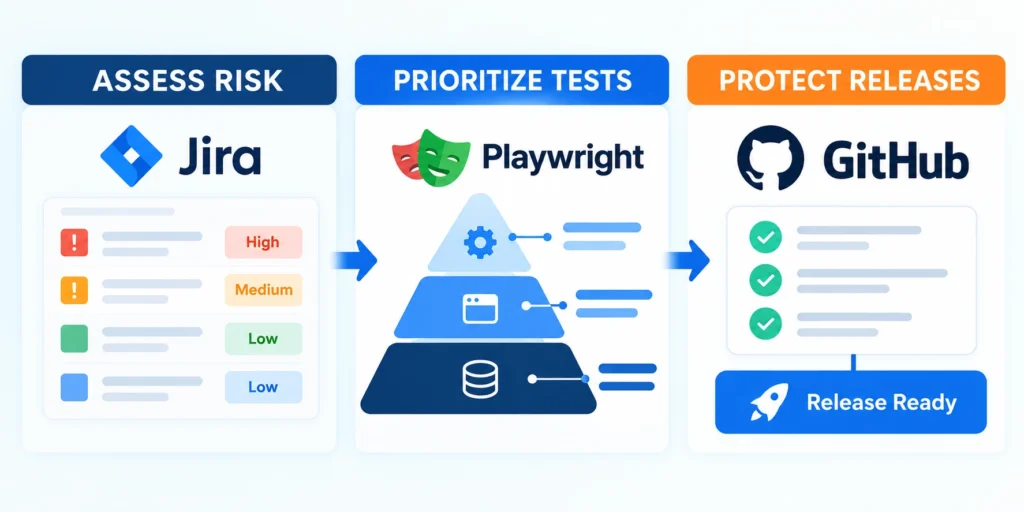
Do not aim to test every possible state equally. Prioritize likely failures that would cause serious customer, financial, privacy, or operational harm.
Use risk to decide which behaviors need deeper coverage, which environment should exercise them, and what evidence release owners need.
Map critical journeys and failure impact
List the journeys that create value or protect customer data: sign-in, permissions, search, checkout, billing, export, and account recovery.
For each journey, estimate impact, likelihood, exposure, and how quickly the team could detect a failure.
Include real-world failure conditions
Consider tenant boundaries, roles, browser differences, network interruptions, expired sessions, duplicate requests, and partial outages.
A useful risk record stays short: scenario, impact, likelihood, owner, control, test evidence, and release response.
Follow this sequence to include real-world failure conditions:
- Identify the user and business action.
- List what must be true before the action begins.
- Describe a failure that would materially harm the user or business.
- Identify the smallest test that could detect that failure reliably.
- Assign the test to a pipeline stage and name the owner for failures.
Review the list when product behavior, dependencies, data sensitivity, or customer usage changes.
Choose test layers for fast feedback
Use small tests for isolated rules, focused integration tests for component boundaries, and a limited set of browser tests for essential journeys.
This is a design heuristic rather than a fixed percentage. The balance depends on architecture, failure patterns, and how difficult tests are to maintain.
Use the testing pyramid as a heuristic
Google’s guidance on the testing pyramid explains why many focused tests and fewer end-to-end checks can produce faster, more diagnosable feedback.
Keep expensive environment-dependent suites separate from fast checks so developers can get useful results while working locally.
Apply these criteria to the testing pyramid as a heuristic:
- Run deterministic unit tests on every relevant change.
- Run service and database integration tests when those boundaries change.
- Execute a small smoke suite against a deployed build.
- Run broader compatibility, load, and security checks at a cadence suited to the risk.
Do not add an end-to-end test when a smaller test can prove the same contract more reliably.
Track coverage by risk, not one percentage
Code coverage shows which lines or branches executed; it does not prove that assertions checked meaningful behavior.
Track the critical journeys and risks from the product plan, then use coverage as a diagnostic signal for untested code.
Measure coverage against important risks
A service may have high line coverage while missing tenant isolation, idempotency, or permission boundaries.
Use a risk-to-test matrix to reveal gaps without turning a percentage into a release target detached from user harm.
| Risk area | Example question | Useful evidence |
|---|---|---|
| Identity | Can one customer access another tenant’s records? | Authorization tests with distinct tenant fixtures |
| Billing | Can retries create duplicate charges or orders? | Idempotency and repeated-request tests |
| Availability | What does a timeout show to the user? | Dependency failure and recovery tests |
| Data changes | Does a schema migration preserve existing records? | Upgrade tests against representative data |
Revisit high-risk cases after incidents and customer reports. A production defect should inform a regression test at the layer where it can be isolated.
Build Fast, Focused Unit and Component Tests

Unit tests check a small rule in isolation; component tests verify a meaningful part of the application with controlled dependencies.
They are most useful when names, fixtures, and assertions describe behavior the team expects to preserve.
Test business rules with clear examples
Use representative inputs and boundaries: minimum values, missing fields, rounding, time zones, duplicate identifiers, and permission changes.
Write one test for each distinct behavior rather than a large scenario with unrelated assertions.
Encode business rules in assertions
For a pricing rule, encode the business-approved order of discount and tax calculations as the contract.
The following Node.js example uses the built-in test runner. The function is application code; adjust input names and expected values to the documented rule.
import { describe, it } from 'node:test';

import assert from 'node:assert/strict';

import { calculateTotal } from './pricing.js';

describe('calculateTotal', () => {

  it('applies the approved discount and tax rule', () => {

    const total = calculateTotal({

      subtotalCents: 10000,

      discountPercent: 10,

      taxPercent: 8,

    });

assert.equal(total, 9720);

  });

});
Confirm the code against the approved rule
If your rule applies tax before discounts, or rounds at a different point, change the expected result to match the signed-off business requirement.
Keep the approved example and rounding policy beside the test so a future change cannot silently redefine the expected business outcome.
Keep test doubles faithful and small
Use a stub when a dependency must return controlled data; use a mock when the interaction itself is the behavior under test.
Avoid mocking every collaborator. Excessive mocks can make a test pass while the real components fail to integrate.
Exercise boundary and permission states
Use representative fixtures that include missing, malformed, expired, and unauthorized states where those states matter.
Prefer named test cases so a failure explains the condition that broke rather than showing an unexplained index.
Use these actions to exercise boundary and permission states:
- Keep test setup close to the scenario.
- Use factories for repeatable valid objects.
- Make invalid or boundary cases explicit in the test name.
- Reset shared state between tests.
When fixtures become difficult to understand, simplify the application boundary or introduce a focused builder rather than hiding setup in global helpers.
Protect data and time boundaries
Test dates in a fixed zone and clock. A test that depends on the machine’s current time can fail near midnight or daylight-saving changes.
Use an isolated database or transaction strategy for tests that need persistence. Never point automated destructive tests at production data.
Verify migration recovery
Test rollback and migration behavior against a representative older schema before a release with database changes.
Verify forward migration, rollback limits, data compatibility, recovery timing, and the operator evidence required before production deployment.
Test APIs and Integrations
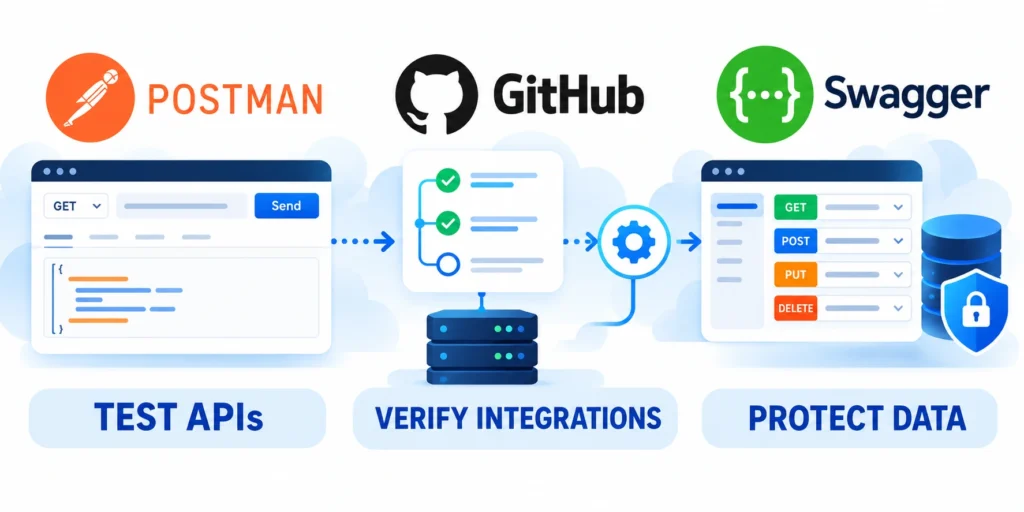
Integration tests verify that services, databases, queues, and external providers exchange data according to agreed contracts.
They catch boundary defects without paying the cost and flakiness of testing every flow through a real browser.
Validate requests, responses, and errors
Test required fields, type constraints, authorization, pagination, rate limits, and stable error behavior at API boundaries.
Verify status codes and response schemas, but also assert business outcomes such as stored state or emitted events.
Keep API contracts focused on consumers
Use contract tests when teams deploy services independently. A contract should describe the consumer’s actual needs, not every field a provider happens to return.
Use these actions to keep api contracts focused on consumers:
- Send valid input and confirm the response and persisted result.
- Omit required input and check that no partial write occurs.
- Use an unauthorized identity and verify access is denied.
- Repeat a request with the same idempotency key and confirm duplicate effects do not occur.
- Simulate a dependency timeout and verify the application responds safely.
Test retries carefully. A retry can be appropriate for a transient network error, but it must not repeat a non-idempotent payment or create a duplicate record.
Isolate external services without hiding risk
Use provider sandboxes for a small number of end-to-end integration checks and controlled fakes for predictable failure cases.
Record which behaviors were tested against a fake and which were confirmed against the provider’s current environment.
Refresh contracts when dependencies change
Refresh contract assumptions when an integration changes version, authentication method, payload shape, or service-level behavior.
Do not silently make every test pass by returning canned success responses. A fake should model the contract, including realistic errors and latency where relevant.
Protect non-production test access
Keep test credentials in a secret manager and use separate low-privilege accounts for non-production environments.
Rotate access on schedule, audit retrieval, isolate customer data, and remove temporary permissions after the integration test completes.
Automate Critical Browser Journeys
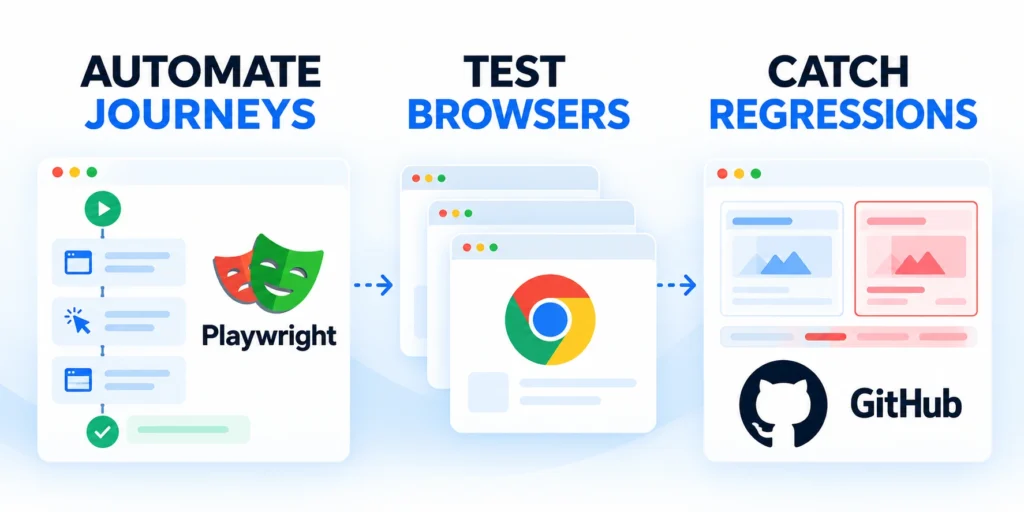
Browser tests verify that a small set of high-value user journeys work across the application’s real front end and deployed services.
They are slower and more failure-prone than focused tests, so select journeys where cross-layer behavior matters.
Use stable locators and observable outcomes
Prefer accessible roles, labels, and stable test identifiers over selectors tied to styling or deep DOM structure.
Wait for the user-visible result rather than sleeping for an arbitrary duration. Fixed delays make tests slower and still fail under load.
Use these practices for stable browser journeys:
- Prefer accessible roles and labels.
- Wait for observable user outcomes.
- Control test accounts and created records.
- Use approved sandbox dependencies.
- Capture diagnostics only after failures.
Keep browser smoke tests focused
A smoke journey should cover a customer action from start to finish without becoming a full copy of every unit test.
This Playwright example assumes a dedicated staging account and a staging base URL configured outside the test source.
import { test, expect } from '@playwright/test';

test('member can create a project', async ({ page }) => {

  await page.goto('/login');

  await page.getByLabel('Email').fill(process.env.QA_EMAIL!);

  await page.getByLabel('Password').fill(process.env.QA_PASSWORD!);

  await page.getByRole('button', { name: 'Sign in' }).click();

  await expect(page.getByRole('heading', { name: 'Dashboard' })).toBeVisible();

  await page.getByRole('link', { name: 'New project' }).click();

  await page.getByLabel('Project name').fill('QA smoke project');

  await page.getByRole('button', { name: 'Save' }).click();

  await expect(page.getByText('Project saved')).toBeVisible();

});
Use the product’s actual accessible labels
The example uses accessible labels and verifies a user outcome; replace the labels with the product’s real accessible names.
When a label changes intentionally, update the product and test together after confirming the revised accessible name with the approved interface.
Control data, state, and flakiness
Create a known test account and clean up only the records the test created. Shared accounts and order-dependent tests cause collisions in parallel runs.
Avoid relying on third-party production services during each browser test. Use a sandbox or controlled test boundary for repeatable checks.
Treat flaky tests as instability evidence
Track flaky results separately from product defects. A retry that passes is evidence of instability, not proof the first failure can be ignored.
The Playwright trace viewer captures actions and diagnostics to investigate CI failures.
Preserve diagnostics without exposing data
Retain traces on failure or the first retry, and remove personal data, secrets, and customer records before sharing artifacts.
Define retention, access, redaction, and deletion for screenshots, videos, network logs, console output, and downloaded test attachments.
Include Security, Accessibility, and Compatibility Checks
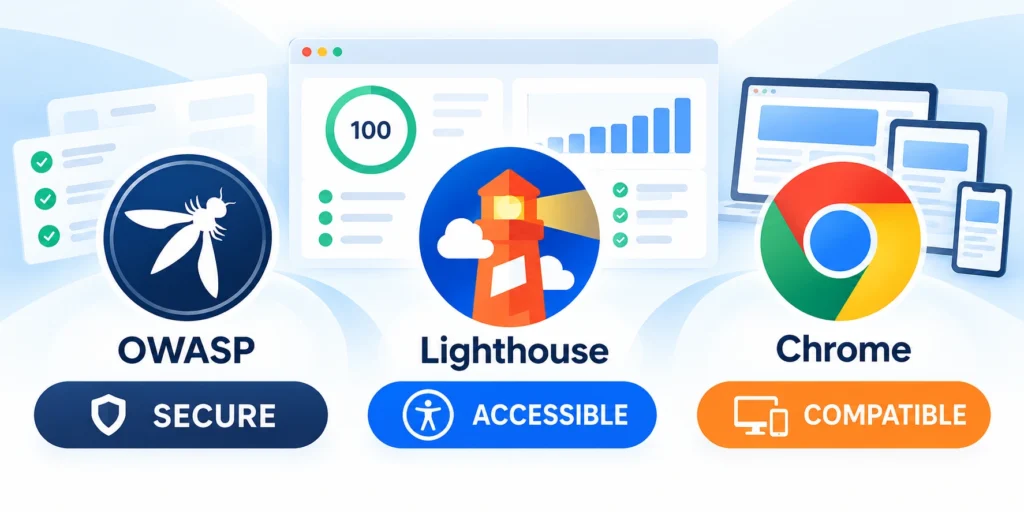
Functional success is not enough if an unauthorized user can reach the data or a keyboard user cannot complete the journey.
Add security, accessibility, and browser checks to the risk plan, and assign owners for findings that require specialized review.
Test authorization and common security boundaries
For each protected operation, test the expected role, a lower-privilege role, an unauthenticated request, and a different tenant.
Check that session expiration, password reset, rate limits, file uploads, and errors follow the application’s security requirements.
Use security guidance with a threat model
OWASP’s Web Security Testing Guide provides practical techniques across authentication, authorization, session management, input handling, and deployment configuration.
Use it as a source of test ideas matched to your threat model, not as a generic checklist that replaces security expertise.
Apply these criteria to security guidance with a threat model:
- Confirm an account cannot access another tenant’s record by changing an identifier.
- Confirm secrets and personal data are absent from URLs and routine logs.
- Test expired and revoked sessions against protected endpoints.
- Check that error messages do not expose stack traces or sensitive configuration.
Schedule dedicated security review for high-risk changes; automated checks cannot establish that an entire system is secure.
Check accessibility and supported browsers
Include keyboard-only operation, visible focus, semantic names, form errors, and zoom behavior in critical user journeys.
Automated accessibility scanners can catch some missing labels and contrast problems, but they do not replace manual assistive-technology checks.
Test the supported browser matrix
Define the browsers and viewport sizes the product supports from actual customer data and contractual requirements.
Test core flows on the supported matrix rather than attempting every browser and device combination without a reason.
Make CI Results Actionable

Run checks at the stage where they provide useful feedback: fast tests on every change, larger suites before merge or release, and specialized checks when risk warrants.
Keep build, unit, integration, browser, security, and compatibility results distinguishable so a failure points toward an owner and next action.
Order the pipeline around feedback speed
Start with formatting, static checks, and focused tests that run quickly. Run expensive services and browser suites after basic code quality passes.
Use parallel jobs only when tests are isolated and the extra resource use improves overall feedback time.
Keep CI caches from hiding stale builds
Cache dependencies safely, but ensure a cache cannot hide a stale build or skip required validation.
Publish the failing test name, environment, commit, logs, and an actionable diagnostic link with each failed run.
Treat retries and quarantines as tracked exceptions
Retries can expose intermittent issues, but a green retry should not erase the original failure from reporting.
Label a flaky test, record its owner and removal date, and keep it visible while the cause is investigated.
Manage temporary test quarantines
Quarantine only when the test blocks unrelated work and the team has a written plan to restore it.
Key considerations for manage temporary test quarantines include:
- Preserve the failing run and the retry outcome.
- Compare environment, test data, timeouts, and dependency availability.
- Reproduce with a focused test or trace before changing product code.
- Remove temporary quarantine after the defect is fixed and the test is stable.
Do not increase timeouts or retries as the first response to a failure. Confirm that the wait is genuinely too short and the action has a bounded expected duration.
Roll Out and Improve Quality

Use test results to make a release decision, then continue observing production behavior because no test suite perfectly predicts real usage.
Connect each release risk to a monitoring signal and a rollback or mitigation action before enabling a broad rollout.
Use a staged release and recovery plan
For a high-impact change, deploy to a limited group, verify core signals, and expand only when the product behaves as expected.
Agree in advance on who can pause rollout, how customers are informed, and how data changes can be reversed or repaired.
Follow this sequence to use a staged release and recovery:
- Capture the current service and data baseline.
- Deploy to a controlled environment and run the smoke suite.
- Enable the feature for a small, representative cohort.
- Review errors, latency, task completion, support contacts, and security signals.
- Expand gradually when the release owner accepts the evidence.
- Pause or roll back when a defined threshold is crossed.
Make the recovery plan concrete. A rollback may not reverse a database migration, sent notification, payment, or external side effect.
Define release gates and rollback evidence
Connect each release gate to a named risk, evidence source, decision owner, stop condition, and recovery action instead of treating every failure equally.
Require these records before expanding a release:
- Passed critical journeys and contracts.
- Reviewed security and accessibility findings.
- Known exceptions with accountable owners.
- Rollback test and confirmation signals.
- Monitoring coverage for changed behavior.
Keep the gate narrow enough to remain actionable. A warning without ownership, impact, or next action becomes noise and encourages unsafe overrides.
Improve Testing From Incidents and Delivery Data

Quality systems should change when incidents, escaped defects, slow diagnosis, unstable tests, support demand, or delivery delays reveal a missing or ineffective control.
Add the smallest reliable check that would have detected the failure at the fastest appropriate layer, then verify that the new signal remains actionable.
Learn from production and delivery evidence
Review escaped defects with the customer journey, requirement, implementation, test coverage, release evidence, monitoring, and recovery procedure in the same discussion.
Use these signals to prioritize improvement:
- Customer impact and affected journey.
- Detection source and diagnosis time.
- Missing or misleading automated signal.
- Repeated manual verification effort.
- Recovery delay and rollback effectiveness.
Do not add a browser test when a focused unit, contract, integration, accessibility, or monitoring check would detect the same risk faster and more reliably.
Retire obsolete and misleading tests
Remove tests when approved requirements disappear, boundaries change, or another control provides clearer evidence with lower maintenance and faster feedback.
Review these candidates during suite maintenance:
- Tests for removed product behavior.
- Duplicated checks at slower layers.
- Permanently quarantined unstable tests.
- Assertions unrelated to customer outcomes.
- Fixtures hiding obsolete assumptions.
Preserve the reason, owner, replacement evidence, and removal date. A smaller current suite can provide more confidence than accumulated historical checks.
For a broader release workflow, see continuous integration and deployment for business apps.
Remove tests when requirements change
Remove obsolete tests when behavior changes. A suite that keeps every historical assumption becomes expensive and misleading.
For a broader release workflow, see this guide to continuous integration and deployment for business apps.
Assign quality across delivery roles
Keep quality ownership shared across product, engineering, operations, and support. Automation assists decisions; it does not replace clear responsibility.
Assign owners for acceptance criteria, automated coverage, release decisions, production monitoring, incident learning, and retirement of obsolete tests.
FAQ
These answers clarify common QA coverage, automation, CI, browser testing, security, test-data, flakiness, and regression-priority decisions.
How many automated tests should a web app have?
There is no useful universal count. Cover important user and business risks with a mix of focused unit, integration, and a smaller number of end-to-end checks.
Is code coverage a reliable measure of quality?
Coverage shows what code executed, not whether tests asserted the right behavior. Use it to find gaps, then prioritize by user and system risk.
Should every browser test block a release?
Only tests for release-critical behavior should be hard gates. Separate advisory and specialized checks from the small set that protects essential journeys.
Are retries a good way to fix flaky tests?
Retries can preserve diagnostic evidence, but they do not correct flakiness. Track retry-passing failures, investigate causes, and avoid treating them as clean passes.
When should a team run security testing?
Include basic security checks throughout development and schedule deeper review when exposure, sensitive data, architecture, or threat assumptions change.
Which tests belong in pull-request CI?
Run fast, deterministic checks that protect changed code and critical contracts. Keep slower broad suites on scheduled or pre-release pipelines when feedback time would become excessive.
Measure duration and failure value. A gate should provide actionable feedback and avoid blocking delivery for unrelated, unstable, or environment-dependent checks.
How should test data be managed?
Use synthetic or approved sanitized records, and keep production personal data out of lower environments.
Reset state between tests and record ownership for shared datasets. Stable data reduces false failures and makes local and CI results easier to reproduce.
What makes an end-to-end test valuable?
It should protect a high-value user journey across boundaries that focused tests cannot verify. Keep setup explicit and assertions tied to observable business outcomes.
Use fewer end-to-end tests than unit or integration tests. Their broader scope usually increases execution time, environment dependency, and diagnostic cost.
How can teams reduce flaky tests?
Control time, randomness, network dependencies, shared state, and asynchronous waits. Replace arbitrary sleeps with conditions based on the behavior the test expects.
Capture traces, logs, screenshots, and environment details on failure. Quarantine only with an owner, reason, and deadline for repair.
How should QA prioritize regression coverage?
Rank journeys by customer impact, revenue, data sensitivity, change frequency, and failure history. Cover the highest combined risk first.
Update the ranking after incidents and product changes. Regression coverage should follow current risk rather than preserve every historical test indefinitely.
Conclusion
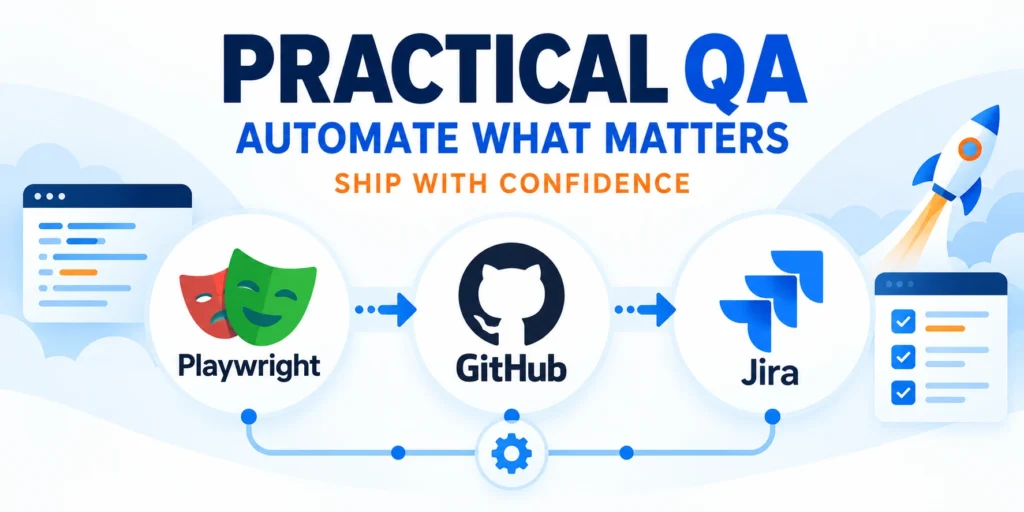
A useful QA system connects customer outcomes to risk-based coverage, fast feedback, meaningful CI evidence, secure diagnostics, and a controlled release and recovery plan.
Begin with important journeys, make failures diagnosable, and improve or retire tests whenever production and delivery evidence changes the risk.
Connect QA to integration governance
Shared ownership matters when failures cross application, API, database, browser, infrastructure, accessibility, security, and third-party boundaries.
Maintain these controls with every critical integration:
- Named journey and contract owners.
- Risk-based automated release gates.
- Protected diagnostic evidence after failures.
- Rollback tests matching release procedures.
- Coverage review after interface changes.
- Accessibility and security review ownership.
- Vendor sandbox and failure assumptions.
Assign acceptance criteria, test maintenance, incident review, production signals, release decisions, and recovery ownership before deployment.
Measure confidence through current evidence
Test counts and one coverage percentage cannot represent product quality. Review whether important risks have reliable signals at appropriate layers.
Use these outcomes during quality reviews:
- Escaped defects by customer impact.
- Feedback speed for changed components.
- Flaky and quarantined test trends.
- Diagnosis and recovery time.
- Manual verification still required.
- Release-gate overrides and outcomes.
- Obsolete tests removed on schedule.
Invest where evidence shows a gap, and remove checks that no longer protect current behavior. Quality engineering should clarify decisions rather than inflate the suite.
For related governance, read the Custom API Development and Third-Party Integrations Playbook.




Leave a Reply